7 Powerful Strategic Thinking Exercises To Use in 2026

Lorem ipsum dolor sit amet, consectetur adipiscing elit. Ut elit tellus, luctus nec ullamcorper mattis, pulvinar dapibus leo.
Lorem ipsum dolor sit amet, consectetur adipiscing elit. Ut elit tellus, luctus nec ullamcorper mattis, pulvinar dapibus leo.
Key Takeaways
- These Strategic Thinking exercises sharpen judgment, broaden perspective, and improve decision-making under pressure.
- Scenario Planning and SWOT create clarity by forcing you to examine multiple futures and separate what you can influence from what you must adapt to.
- Five Forces and Blue Ocean expose real opportunities one reveals structural risks; the other pushes you to escape crowded markets and pursue uncontested value.
- War Gaming stress-tests your assumptions and shows how competitors, customers, and regulators might actually react, before you commit resources.
- Design Thinking and Build-Measure-Learn eliminate guesswork by grounding strategy in real user needs and rapid experimentation, turning ideas into evidence-backed moves.
Introduction
Strategic thinking isn’t reserved for CEOs; it’s a practiced skill you can build with the right exercises.This piece is my toolkit of seven practical strategic thinking exercises you can use this year. Each workout is written for product managers, founders, and mid-level managers who need concrete ways to sharpen their strategy and make better decisions under pressure.
Think of these as repeatable drills that fit into your week.
Also Read: Strategic Thinking in Business: Harvard Teaches VS Real Life!
Scenario Planning
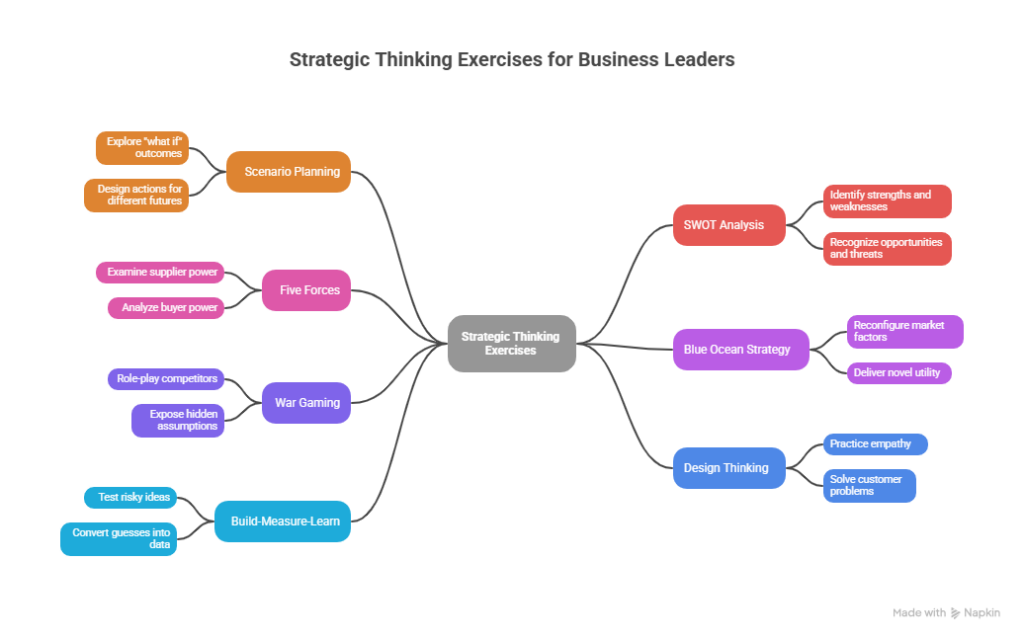
Scenario Planning trains you to anticipate multiple plausible futures instead of placing a bet on a single forecast. This strategic thinking exercise helps teams to explore “what if” outcomes, and design actions that hold up across very different futures. The point is not only to predict but also to prepare and increase your strategic agility.
SWOT Analysis
SWOT is a fast, dependable framework for evaluating where your company or product stands by listing Strengths, Weaknesses, Opportunities, and Threats. As a strategic thinking exercise, it separates internal factors you can influence from external forces you must respond tomaking it a practical starting point for turning insight into action.
SWOTs power is its simplicity: you can apply it to a full company, a product launch, or even your own career.
Also Read: Why Mastering Strategic Thinking Can IncreaseYour Exam Scores?
Five Forces
Porter’s Five Forces is a practical way to map the structural pressures that determine an industry’s attractiveness. Rather than focusing only on direct rivals, this strategic thinking exercise forces you to examine supplier power, buyer power, substitutes, new entrants, and rival so you can find defensible positions and clearer strategic moves.
It’s used by startups and large companies alike because it reveals where profits flow and where they leak. What would happen to your margins if a single supplier raised prices 20% tomorrow? Asking that kind of question uncovers risks you can manage before they become crises.
Blue Ocean Strategy
Blue Ocean Strategy challenges you to stop fighting over the same customers and instead invent a new playing field where competition is irrelevant. This strategic thinking exercise focuses on value innovation reconfiguring which factors your market competes on so you deliver novel utility at the right price and cost.
War Game
War Gaming turns abstract competitive analysis into a live rehearsal: teams role-play competitors, customers, regulators, and suppliers to surface how the market might actually respond to your moves. As a strategic thinking exercise, it exposes hidden assumptions, pressure-tests strategy, and reveals practical contingencies you can operationalize before real-world stakes rise.
Although the technique has military roots and has been promoted by consultancies like BCG and McKinsey, you can run scaled versions that fit a mid-size company or product team.
Design Thinking
Design Thinking puts real people at the center of strategy: by practicing empathy first, you uncover needs that lead to genuinely useful and desirable products. This strategic thinking exercise shifts the conversation from “what can we build?” to “what problem should we solve?”ensuring your product decisions are both customer-informed and strategically sound.
Design Thinking scales from startups to hospitals because it forces teams to test assumptions with actual customers rather than guesswork.
Also Read: Design Thinking as a Skill and How It Helps in Marketing.
Build-Measure-Learn
The Build-Measure-Learn loop is the engine of validated learning: instead of long plans and assumptions, this strategic thinking exercise pushes you to test your riskiest ideas quickly with real customers. By cycling through rapid experiments, teams convert guesses into data-driven decisions and reduce the chance of building products nobody wants.
Popularized by Eric Ries and rooted in Steve Blank’s customer development work, this approach moves strategy out of slide decks and into tangible market tests. It’s essential for product teams, founders, and managers who need to turn ideas into measurable progress while keeping risk and cost low.
Also Read: Scale Your Business in 90 Days.
Conclusion
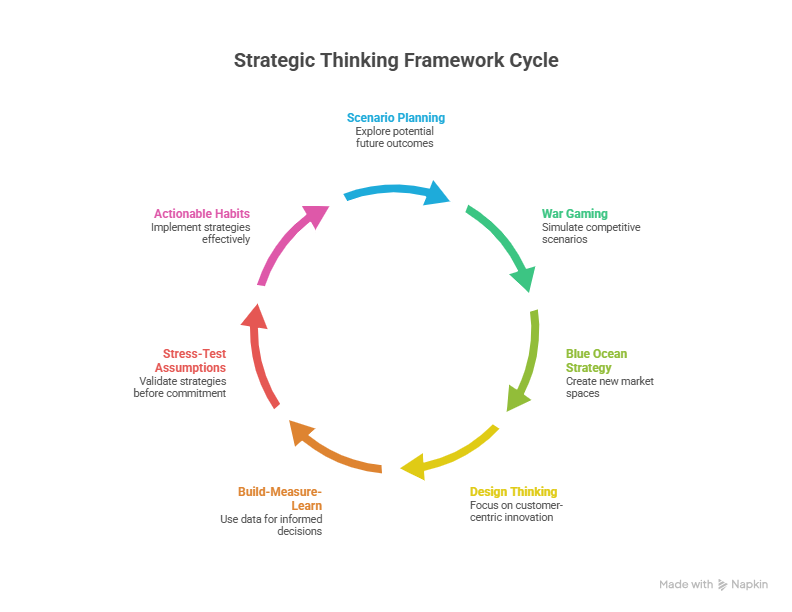
Strategic thinking only improves when you put it under stress, test it, and refine it.
These seven exercises are the tools you should run repeatedly until they shape how you see problems, markets, and decisions. Scenario Planning widens your view. SWOT forces clarity. Five Forces keeps you honest about industry realities. Blue Ocean pushes you to challenge assumptions instead of competing blindly. War Games reveal how opponents and customers actually behave, not how you wish they would. Design Thinking grounds your strategy in real human needs. And Build-Measure-Learn ensures you stop speculating and start learning from real data.
That’s the real edge for 2026, not intelligence, not experience, but the discipline to test your thinking before the market does it for you.

Makarand S is a content writer who focuses on importance of soft skills and job readiness. Through his articles, He identifies potential gap areas and demonstrates easy and practical ways to overome them. With a keen interest in Skill Development, Makarand explores the shift in job landscapes and strategies for continuous learning. His articles help readers in preparing for the rapidly evolving nature of work more
Submit the form we will reply within Next 24 hours


Develop Must-Have Skills To Navigate Workplace Challenges And Build Executive Presence
Explore Topics
- AI-Driven Skill Development (7)
- Communication Skills in Indian English (12)
- Confidence Building for Students (5)
- Entrance Test Updates (2)
- Government Job Mindset Training (4)
- Lifelong Learning for Indian Women (3)
- Personality Development for IT/BPO (7)
- Public Speaking in Hindi/Marathi (1)
- Rural Empowerment via Soft Skills (0)
- Soft Skills for Indian Careers (11)
- Strategic Thinking for Entrepreneurs (29)
- text (0)
- Uncategorized (2)