
Why Mastering Strategic Thinking Can Increase Your Exam Scores?
Learn how deliberate planning and targeted practice helps you increase score.
Lorem ipsum dolor sit amet, consectetur adipiscing elit. Ut elit tellus, luctus nec ullamcorper mattis, pulvinar dapibus leo.
TL;DR
Mastering strategic thinking transforms exam prep!
It helps you spot question patterns, plan smarter, and make better choices under pressure. Instead of cramming, use active recall, spaced practice, and focused review. Students who think strategically study more effectively, stress less, and score higherthese habits lead to both exam success and lifelong skills for work.
Key Takeaways
- Mastering strategic thinking gives you a practical advantage in high-stakes tests — it’s planning plus smart tactics, not just harder hours.
- Strategic thinking helps you plan study time, pick the right resources, and convert study into test-ready recall.
- Swap rote routines for proven methods (active recall, spaced repetition, timed practice) to improve strategic study outcomes.
- Strategic thinking is about extracting key information, spotting trends in past papers, and making calculated choices during the test.
- Mini case: Riya raised her mock scores by focusing on 10-minute question breakdowns and a weekly plan — small, repeatable actions win.
Introduction

In today’s fast-paced world, teamwork is more important than ever. With more people working remotely, teamwork skills are key to success. They help us work together effectively.
More people are working in teams, thanks to remote work. This means we need agile teams that can work well together. Good teamwork skills make businesses more productive and innovative.
Teamwork will keep shaping the future of work. By focusing on teamwork skills and remote collaboration, businesses can thrive in today’s complex world.
Also Read : What Is Teamwork and Why Does It Matter?
How strategic thinking boosts your exam scores
Unlike pure memorisation, strategic thinking focuses on selecting high-value information, designing practice that mirrors the exam, and using feedback to iterate your plan. These are the same thinking skills leaders use in business strategy:small, repeatable moves that compound into big gains over time.
Studying more strategically equals improved exam scores
Research backs this up: methods such as retrieval practice and spaced repetition consistently outperform simple rereading (see Dunlosky et al. for a useful summary). One accessible piece from Stanford highlights how studying with exam-style practice and timing can improve performance by making you familiar with question patterns and time pressure.
Practice tests aren’t just drills — they’re diagnostic tools. They show which topics need targeted work, reveal timing leaks, and let you practise the exact strategy you’ll use on test day. For example, doing a timed mock, reviewing errors, and scheduling focused follow-up sessions is the basic loop behind many success stories.
How to translate this into a mini framework:
- Analyse past papers for common question types (analysis)
- Plan weekly drills that target those types (strategic planning)
- Use timed practice and retrieval cycles (strategy + feedback)
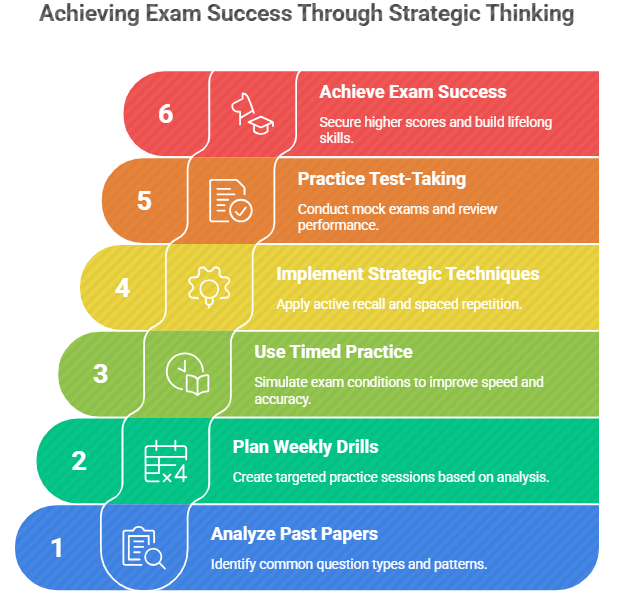
These steps borrow from business strategy; where leaders test tactics, measure outcomes and pivot — and adapt them for your study routine so you get measurable success.
Also Read : Only 5% of Students Think Strategically : Global Guide for Study-Abroad Success
How to start mastering strategic thinking today
The aim is simple: understand the exam landscape, set clear goals, and replace unfocused hours with targeted practice that builds reliable recall and confidence.
Define a clear “end goal” with smaller objectives
Pick a realistic target (score or percentile) and break it into weekly micro-goals. Instead of “get better at maths”, set: “raise algebra accuracy from 70% to 85% in four weeks”. This is strategic planning: a clear goal plus measurable checkpoints so you can adjust tactics.
If a 1500 target on a 1600 scale is your stretch goal, decompose it by section — what each section needs numerically — or pick improvement bands (e.g., +10% accuracy in reading, +8% in math). That makes progress visible and less overwhelming.
Implement strategic learning techniques
Use evidence-based techniques that give the biggest returns for the time invested: active recall (flashcards or self-quizzing), spaced repetition (space reviews over days/weeks), and timed practice. Pair these with focused time blocks — Pomodoro or 90-minute deep sessions — to protect concentration.
Quick template to paste into Notion or Google Sheets: Topic | Last Mock Score | Time Spent | Next Drill | Review Date. Use it every week to track trends and turn data into insights.
For foundational reading on sharpening these skills, see this HBS primer.
Practice strategic test-taking in advance
Make the mock exam loop your core habit: take a timed mock, review errors for patterns, schedule targeted drills, then retest. That loop is scenario planning at study scale — test a tactic, measure outcomes, pivot if needed.
10-minute drills you can start now: skim five past questions to spot recurring traps; do a focused 25-minute Pomodoro on one weak topic; then review one mistake and note the exact thought error. Repeat weekly to compound gains.
Also Read : Microlearning: The Future of Lifelong Learning
Before the Exam
Preparing for the big day is less about last-minute panic and more about a few targeted habits. A strategic approach before the exam turns scattered hours into high-impact practice: plan deliberately, protect your time, and use feedback to improve.
Proactive Learning
Proactive learning means deciding what matters and acting on it. Don’t study everything badly — study the right things well. Tonight: pick three topics that appear most often in past papers and plan focused drills for each.
Becoming a strategic thinker is partly habit work: James Clear’s habit-stacking idea helps here — attach a quick 10-minute review to an existing routine (e.g., after breakfast) to make it stick.
Resource Management
Use the resources you have, but use them strategically. Rather than bookmarking endless videos, choose one trusted source per topic and schedule drills from it. Study groups are great for explaining tricky ideas; tutors help with focused weaknesses. Treat each resource like a tool with a single purpose.
Metacognition
Metacognition is the core planning skill. After each mock, ask: What error pattern emerged? Where did time leak? Change the plan based on those answers. A simple tracker works: Topic | Error Type | Next Step.
Quick pre-exam week checklist you can copy into Notion:
- Time-block three daily study windows (one 90-minute deep block).
- Schedule two full timed mocks and one targeted drill session.
- Limit edits: allow only two review passes per mock to beat perfectionism.
- Use Pomodoro (25/5) for mixed tasks; use a single-source material per topic.
- Log one specific improvement goal for the week (e.g., +10% accuracy on algebra problems).
- Conflict: Different views or ways of doing things can cause team fights.
- Lack of Trust: Without trust, working together is hard.
- Poor Communication: Bad communication leads to mistakes and misunderstandings.
By using proactive learning, managing resources, and practising metacognition, you make each hour count. These strategic thinking moves are the same planning habits leaders use in business — small, repeatable processes that compound into real results.
Also Read : Hybrid Workplace Communication 2026: 5 Proven Strategies to Fix Communication Gaps & Boost Team Productivity
During the Exam
When you sit the test, strategic thinking helps you stay calm and use your time like a resource, not a threat. It isn’t just about what you know — it’s about the order you attack the paper, how you prioritise, and the small tactics that save minutes and points.
Question Deconstruction
Complex questions fall apart when you break them down. Deconstruction is a small analysis process that turns overwhelm into clear tasks.
How to deconstruct (do this in 30–60 seconds):
- Identify the topic and any data or figures given.
- Underline task words (solve, compare, explain) so your answer matches the demand.
- Outline three quick steps to solve it before you write anything.
Process of Elimination — fast drill
The process of elimination is a tactical tool for multiple-choice questions — and a three-step drill you can rehearse.
- Scan options for obviously wrong answers.
- Cross out those options and reassess what’s left.
- Choose the best remaining option or flag to revisit if unsure.
Replace that table in practice with a quick mantra before each MCQ: “Scan → Eliminate → Pick” — say it in your head and keep moving.
Also Read : 7 Powerful Strategic Thinking Exercises To Use in 2026
Conclusion
Improving your exam scores is entirely possible when you treat study as a small-scale strategy project. Strategic thinking teaches you to spot high-value information, plan focused practice, and convert hours into reliable recall — not just fleeting familiarity.
These skills reduce exam stress because preparation becomes predictable: you know what to practise, when to rest, and how to recover from mistakes. Beyond tests, the same approach gives you a real advantage in the workplace. Leaders use scenario planning and rapid feedback loops to solve problems and deliver outcomes.
Arthsetu’s Strategic Thinking Course
Arthsetu’s Strategic Thinking Course is is designed for todays ambitious students and professionals ready to transform challenges into opportunities. This comprehensive program helps you boost confidence, sharpen decision-making, and master strategic problem-solving skills essential for career growth.
Dont wait! book your FREE consultation now!
Key Features Include:
- The Power of Perspective
- Decision-Making in the Real World
- The Ripple Effect: Thinking Beyond Today
- Ethics and Innovation
- Breaking Down Complex Problems
Frequently Asked Questions

Makarand S is a content writer who focuses on importance of soft skills and job readiness. Through his articles, He identifies potential gap areas and demonstrates easy and practical ways to overome them. With a keen interest in Skill Development, Makarand explores the shift in job landscapes and strategies for continuous learning. His articles help readers in preparing for the rapidly evolving nature of work more
Submit the form we will reply within Next 24 hours


Develop Must-Have Skills To Navigate Workplace Challenges And Build Executive Presence
Explore Topics
- AI-Driven Skill Development (7)
- Communication Skills in Indian English (12)
- Confidence Building for Students (5)
- Entrance Test Updates (2)
- Government Job Mindset Training (4)
- Lifelong Learning for Indian Women (3)
- Personality Development for IT/BPO (7)
- Public Speaking in Hindi/Marathi (1)
- Rural Empowerment via Soft Skills (0)
- Soft Skills for Indian Careers (11)
- Strategic Thinking for Entrepreneurs (29)
- text (0)
- Uncategorized (2)