
How Ethics (GS Paper IV) Can Be Your Highest Scoring Paper
Lorem ipsum dolor sit amet, consectetur adipiscing elit. Ut elit tellus, luctus nec ullamcorper mattis, pulvinar dapibus leo.
Lorem ipsum dolor sit amet, consectetur adipiscing elit. Ut elit tellus, luctus nec ullamcorper mattis, pulvinar dapibus leo.

Key Takeaways
- Knowing the UPSC Ethics paper format is key to getting good marks.
- A clear structure and clarity are vital for high scores.
- Balanced judgment shows you understand complex ethical issues well.
- Good preparation is the secret to doing well in the Ethics paper.
- Think differently about Ethics prep to unlock its full value.
Introduction
You might think the Ethics paper is tough, needing deep thoughts or great morals. But, it’s actually one of the most straightforward and easy papers in the UPSC Mains exam.
Top scorers do well not because they’re more moral. They follow a clear structure, stay clear, and show balanced judgment. Knowing what the paper really tests can help you score high.
The UPSC Ethics paper can really boost your rank and change your game. It’s time to change how you prepare for Ethics and use its full power.
Also Read: How to Prepare for UPSC Prelims in One Year?
What GS Paper IV Actually Tests (And What It Does Not)
GS Paper IV is more than just an exam. It tests a specific skill. Many think it’s about philosophy, not making ethical choices.
Why Aspirants Misinterpret Ethics as a Philosophy Paper
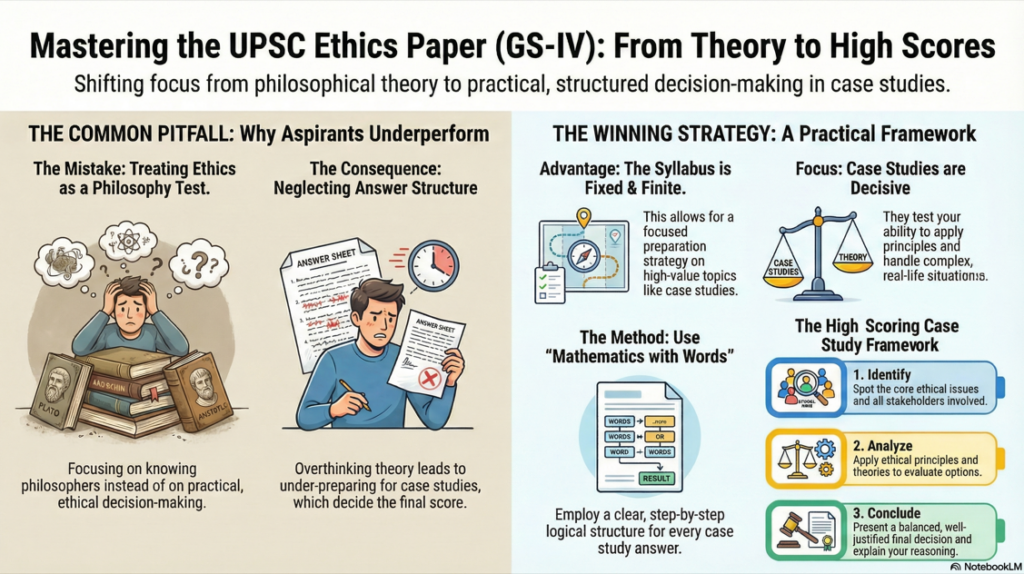
Many see GS Paper IV as a test of moral philosophy. They think knowing big philosophers is key. But, it’s not all about that.
The ethics syllabus for UPSC tests how you apply ethics in real life. It’s about ethical decision-making. You need to analyze, spot dilemmas, and make fair choices.
Ethics as Decision-Making, Not Moral Preaching
GS Paper IV is about solving ethical problems. It tests how you make decisions in a practical and ethical way. You need to choose what’s fair and right for everyone.
To do well, practice ethics case studies UPSC offers. These mimic real-life problems. By solving them, you improve your decision-making. Think clearly and practically, not just by theory.
Realizing GS Paper IV is about making choices, not just knowing theory, helps. Focus on case studies, the upsc ethics syllabus, and practical problem-solving.
Why Ethics Is Considered an Underrated Scoring Paper
Many UPSC aspirants don’t see the value in Ethics (GS Paper IV). But, top performers say Ethics was key to their success. They often ignore it, thinking other papers are harder.
Overthinking Philosophy vs Underpreparing Structure
Aspirants think Ethics needs deep philosophy, leading to overthinking. This makes them forget about the answer structure. They don’t prepare well for scoring.
But, Ethics is really about making decisions, not just moral talks. It tests your ability to solve complex problems clearly. Toppers stress the need for a good case study structure, which many don’t prepare for.
A well-structured answer framework is vital for high marks in Ethics. You need to understand the question, spot the main issues, and give a balanced view. Clear and concise thinking is essential.
To tackle these challenges, focus on a strong case study structure. Practice writing answers quickly. Know the syllabus and question types well. Then, plan your study strategy carefully.
The Biggest Advantage of GS Paper IV — A Fixed, Finite Syllabus
GS Paper IV has a fixed syllabus, which is a big plus. Knowing the UPSC Ethics syllabus helps you focus on key topics. This makes your study plan more effective.
The fixed syllabus of GS Paper IV is a big plus. It lets you prepare well without the worry of other GS papers. You know exactly what to study for the exam.
What “Fixed Syllabus” Means for Preparation Strategy
A fixed syllabus helps you make a GS Paper IV preparation strategy that works well. You can spot important areas like case studies and ethical principles. Then, you can plan your study time better.
It’s key to really get the syllabus and pattern of GS Paper IV. This lets you make a study plan that covers all needed topics. You’ll also practice case studies well.
With this approach, you’ll be ready for the exam. You’ll get high marks in GS Paper IV. This will boost your overall UPSC score.
Learn how to: Improve Communication Skills for UPSC Interview Preparation.
Why Case Studies Decide Your Final Ethics Score
GS Paper IV’s case studies are key to your Ethics score. How you tackle these studies greatly affects your performance.
These case studies test your use of ethical principles, not just your knowledge. They check if you can handle complex situations. You must make decisions that balance different needs and ethics.
Learn More: Ethics case studies (2013–2023) compiled topic-wise for GS-4.
What the Examiner Actually Evaluates in Case Studies
The examiner looks for practical ethical decision-making in your answers. They check if you can:
- Spot the ethical issues
- Understand the effects of different actions
- Make a decision that’s right and justifiable
- Share your thought process clearly
They don’t just want the ‘right’ answer. They want to see your critical thinking and sound judgments. Your answers should show emotional intelligence, integrity, and skill in complex situations.
To do well in case studies, use a structured approach. Understand the scenario, find the main ethical issues, and apply ethical principles to make a good decision.
Mastering case studies can greatly boost your GS Paper IV score. It’s about showing you can use ethics in real, effective ways.
Learn how to write Ethics case studies answers (concept questions + case questions, both 125 marks)
The Hidden Scoring Framework Behind High-Marks Case Studies
Getting top marks in GS Paper IV case studies means understanding what examiners look for. Toppers use a structured approach to ace these questions.
Structured Logic: The Hallmark of High-Scoring Answers
Answering case studies in Ethics is like doing mathematics with words. This shows how important a clear, step-by-step method is. Just like solving math problems, you need to break down and analyze each part of the case study.
Start by breaking down the case study into parts. Then, analyze each part carefully. After that, put all your findings together into a clear answer. This is like using formulas to solve math problems, but with ethics.
Key elements of a top case study answer include:
- Understanding the ethical sides of the case
- Breaking down the case into key parts and stakeholders
- Using ethics to guide your decisions
- Ending with a balanced view of the options
Using this structured logic makes your answers detailed and examiner-friendly. This helps you get more marks.
Practical Tips for Implementing the Framework
First, get to know the case study question well. Then, spot the main ethical issues and who’s involved. Outline your answer in intro, analysis, and conclusion sections.
In your analysis, use ethical principles and theories to guide your decisions. End by summarizing your main points and the ethical reasons behind them.
By sticking to this method and practicing with examples, you can do well in GS Paper IV case studies. This will help you get high-scoring results.
Learn More: GS-4 (Ethics) trend analysis, topic-wise weightage and word counts.
Why Ethics Improves Rapidly With Practice (Unlike Many GS Papers)
GS Paper IV stands out because it can improve quickly with practice. Unlike other subjects, Ethics doesn’t need deep concept knowledge or lots of memorization. It can be mastered by writing answers regularly.
How Repeated Case Practice Builds Ethical Muscle Memory
Practicing case studies over and over is key to building “ethical muscle memory.” Like athletes or musicians, you get better at solving ethical problems with practice. This makes you quick to spot the right action in ethical situations.
Regular practice in Ethics answer writing boosts your clear thinking and applying ethics in life. By doing case studies often, you gather ethical knowledge and strategies for the exam.
The idea of ethical muscle memory means you can use ethical rules and models without thinking in exams. This comes from repeated practice, making you more confident and skilled in solving ethical problems.
It’s important to look back at your practice and see what you’re good at and what you’re not. This helps you get better at Ethics answer writing and prepares you well for GS Paper IV.
Why Toppers Consistently Score 110–130+ in Ethics
Scoring 110+ in Ethics isn’t about complex ideas. It’s about clear and balanced writing. Toppers in the Ethics paper (GS Paper IV) know what examiners want. They use a smart way to answer questions.
They write clearly and concisely. This is key to their success. It’s not just about simple words. It’s about answering the question directly.
Simple Language, Balanced Decisions, Examiner-Friendly Writing
Toppers use simple language to explain complex ideas. They avoid hard words and technical terms. This makes their answers easy to understand.
Balanced decisions are also important. Toppers consider all sides of an issue. They show they can make thoughtful decisions.
They also write in a way that examiners like. Toppers know how to structure their answers. They make sure each part of their answer fits together well.
By using simple language, making balanced decisions, and writing for the examiner, toppers do well. It’s their strategy, not just knowing a lot, that helps them score high in Ethics.
The Most Common Mistakes That Destroy Ethics Scores
Many aspirants forget the importance of practical judgment in Ethics. This leads to answers that are too idealistic but not practical. To get a high score in Ethics, it’s key to show a mix of ideals and practical thinking.
Why Idealism Without Practical Judgment Backfires
Idealism is good, but in administrative ethics, it must be balanced with practical judgment. Practical judgment means thinking about if a decision can be done and its effects. Without this balance, answers might seem too good to be true or hard to do.
In case studies, just saying a decision is right or wrong without thinking about how it works can hurt your score. The examiner looks at both the ethics and if the decision can be done. So, you must back up your choices with both ethics and practical thoughts.
One big common mistake in Ethics UPSC is not giving balanced answers. Aspirants often only think about the ethics, ignoring the practical side. To get better, practice with case studies that need you to mix idealism with practical thinking.
To improve, work on looking at case studies from different sides. Think about the ethics, the limits of administration, and what might happen next. This way, you’ll make answers that are both right and doable, which will help your Ethics paper score.
The Mental Model That Changes Everything in GS Paper IV
Thinking like a responsible officer changes how you tackle GS Paper IV. It makes you better at solving case studies. You show administrative ethics and probity in public life more clearly.
Thinking Like a Decision-Maker
To do well in GS Paper IV, you must think like a decision-maker, not just a moral philosopher. You need to understand the complex challenges of administration. Then, apply ethical rules to real-life problems.
When you face a case study, think: “What’s the best action for a civil servant?” This change in thinking makes your answers more useful and realistic.
Thinking like a responsible officer means you apply ethics in real situations. You show you can handle public service’s complexities. This makes your answers more appealing to the examiner.
Key Characteristics of a Responsible Officer’s Mindset
To get this mindset, focus on these traits:
- Practicality: Mix idealism with the real world of governance.
- Contextual understanding: Think about the social and political setting of your choices.
- Stakeholder analysis: Know and balance the interests of different groups.
By adopting these qualities, you’ll boost your GS Paper IV score. You’ll also gain a deeper grasp of administrative ethics. This mindset will help you in public service and decision-making long after the exam.
Read More: Economics for SSC Exams Explained.
Conclusion
Your GS Paper IV score can really change your UPSC Mains results. By planning well for upsc ethics preparation, you can make this paper a key part of your success. Knowing that ethics gs paper iv is often overlooked is the first step to making the most of it.
A good strategy for GS Paper IV includes knowing the syllabus, mastering case studies, and having a clear way to answer questions. This not only boosts your upsc mains ethics score but also prepares you for tough ethical challenges.
Remember, Ethics is about making decisions, not just talking about morals. By thinking like a responsible officer and using practical judgment, you can get a great score. With regular practice and the right help, you can do well in GS Paper IV and move closer to your UPSC goals.

Makarand S is a content writer who focuses on importance of soft skills and job readiness. Through his articles, He identifies potential gap areas and demonstrates easy and practical ways to overome them. With a keen interest in Skill Development, Makarand explores the shift in job landscapes and strategies for continuous learning. His articles help readers in preparing for the rapidly evolving nature of work more
Submit the form we will reply within Next 24 hours


Develop Must-Have Skills To Navigate Workplace Challenges And Build Executive Presence
Explore Topics
- AI-Driven Skill Development (7)
- Communication Skills in Indian English (12)
- Confidence Building for Students (5)
- Entrance Test Updates (2)
- Government Job Mindset Training (4)
- Lifelong Learning for Indian Women (3)
- Personality Development for IT/BPO (7)
- Public Speaking in Hindi/Marathi (1)
- Rural Empowerment via Soft Skills (0)
- Soft Skills for Indian Careers (11)
- Strategic Thinking for Entrepreneurs (29)
- text (0)
- Uncategorized (2)