
Economics for SSC Exams Explained
Lorem ipsum dolor sit amet, consectetur adipiscing elit. Ut elit tellus, luctus nec ullamcorper mattis, pulvinar dapibus leo.
Lorem ipsum dolor sit amet, consectetur adipiscing elit. Ut elit tellus, luctus nec ullamcorper mattis, pulvinar dapibus leo.

Key Takeaways
- Understand the practical application of economic concepts in SSC exams.
- Learn key economy terms like inflation, repo rate, and GDP.
- Grasp the logic behind economic concepts, not just memorising.
- Discover how to tackle economy questions in SSC exams.
- Explore the importance of concepts like budget deficits and digital economy.
Introduction
Getting ready for SSC exams? Learning about economics can really help. Economics is the study of how we make choices with limited resources. It’s all about scarcity and choice.
It’s not just about learning theories. It’s about using what you learn in real life. For example, knowing about inflation explained for SSC helps you see how prices change. Inflation is when prices go up over time.
Economics also covers things like money policies and digital payments. For instance, understanding repo rate vs reverse repo SSC shows how banks manage money. Also, knowing about fiscal deficit vs revenue deficit SSC helps you understand government money matters.
Economics is more than just numbers and charts. It’s about understanding how economies work. This includes knowing the difference between headline vs core inflation SSC. These are key to understanding economic signs.
In the next parts, we’ll dive deeper into these topics. You’ll get a full grasp of economics for SSC exams. By the end, you’ll be ready to answer economics questions with ease.
Also Read: How to Prepare for Nabard exam.
Inflation Explained for SSC Exams
As you get ready for SSC exams, it’s key to understand inflation. It’s a big economic idea that changes how much we can buy. Knowing about inflation helps you see how it affects the economy and your life.
Inflation Meaning
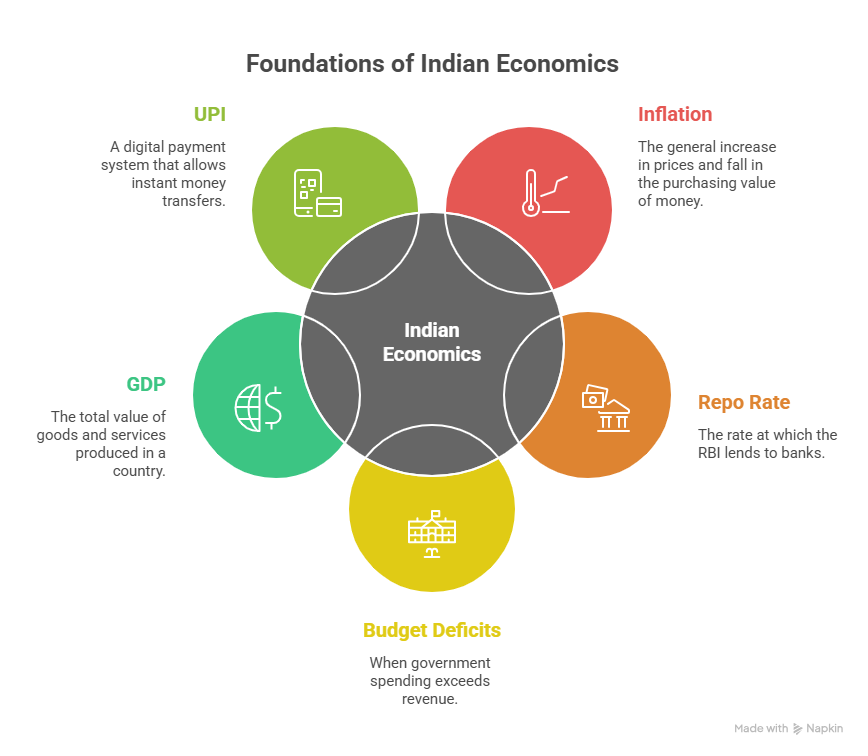
Inflation means prices for things we buy go up, making our money worth less. Imagine a cup of coffee costing £1. If inflation is 2%, it will cost £1.02 the next year. This shows how inflation works.
Many things can cause inflation, like too much demand or higher costs. It affects how much we can save and spend. For example, high inflation can make our savings worth less over time.
Headline Inflation vs Core Inflation
There are two main types of inflation: headline and core. Headline inflation is the overall rate, including all prices. It’s often shown by the Consumer Price Index (CPI). Core inflation leaves out prices that change a lot, like food and energy. This gives a clearer view of real inflation.
For instance, if headline inflation goes up because of oil prices, core inflation might stay the same. This shows the real inflation trend. Knowing this helps you understand economic data better.
Inflation changes our daily life in many ways. It affects how much things cost, interest rates, and savings returns. The Reserve Bank of India (RBI) uses money policies to control inflation. They aim to keep the economy stable and our money’s value safe.
Also Read : 4 Step Solution to Scale a Business in 2026
Repo Rate vs Reverse Repo (Most Asked Banking Concept)
Repo rate and reverse repo are key banking terms for exams. The Reserve Bank of India (RBI) uses them to control money in the economy.
What Is Repo Rate?
The repo rate is the rate at which the RBI lends to banks. Banks borrow from the RBI when they need money. This rate helps control inflation and manage money in the system.
For example, if the RBI raises the repo rate, borrowing becomes more expensive. Banks then charge more for loans. This reduces spending and helps control inflation.
Repo vs Reverse Repo
The reverse repo rate is when the RBI borrows from banks. It’s the opposite of the repo rate. The RBI uses it to manage money and ensure banks don’t keep too much idle.
When the reverse repo rate is high, banks prefer to lend to the RBI. This reduces the money available for loans, controlling liquidity.
The main differences between repo and reverse repo rates are:
- Direction of Transaction: Repo rate is the RBI lending to banks, while reverse repo is banks lending to the RBI.
- Purpose: Repo rate adds money to the system, while reverse repo takes it out.
- Impact on Economy: Lower repo rates help the economy by making loans cheaper. Higher reverse repo rates slow the economy by reducing lending.
Understanding repo and reverse repo rates is key for SSC exams. These concepts are important for exams and show how policies affect the economy.
Also Read: Why Mastering Strategic Thinking Can IncreaseYour Exam Scores?
Budget Deficits Made Easy (Fiscal & Revenue Deficit)
When we look at government money, we often see fiscal deficit and revenue deficit. Knowing these terms helps us understand how government choices affect the economy.
What Is Fiscal Deficit?
A fiscal deficit happens when a government spends more than it makes. This is without counting money it borrows. For example, if a government spends ₹100 crore and makes ₹80 crore, it has a ₹20 crore deficit.
This deficit shows how well a government is doing financially. A big deficit means more borrowing, which can raise interest rates and prices. But, a small deficit can help the economy grow by funding new projects and social programs.
Revenue Deficit vs Fiscal Deficit
Revenue deficit and fiscal deficit both show how a government is doing financially. But they look at different things. A revenue deficit is when a government spends more than it gets in taxes. A fiscal deficit looks at all spending, including big projects.
Let’s say a government spends ₹60 crore on daily things and gets ₹50 crore in taxes, it has a ₹10 crore revenue deficit. But if it also spends ₹40 crore on big projects and gets ₹80 crore in total, its fiscal deficit is ₹20 crore.
For more info on budget deficits, check out the India Budget website. Knowing the difference between revenue and fiscal deficits helps us understand government money choices and their effects on the economy.
Also read : The Art of Slowing Down
GDP vs GNP (India-Specific Understanding)
When we talk about a country’s economy, we often mention GDP and GNP. It’s key to know the difference between them to understand a nation’s economic health. In India, it’s important to know why one is chosen over the other.
GDP Explained in Simple Words
Gross Domestic Product (GDP) is the total value of goods and services made in a country in a year. It includes things like what people buy, invest, and what the government spends. For example, if a foreign company makes things in India, that counts in India’s GDP.
Why India Uses GDP, Not GNP
India, like many others, mainly uses GDP to measure its economy. This is because its economy is complex, and GDP is easier to track. It’s simpler because it only looks at what’s made inside the country.
Now, let’s look at why GDP is preferred over GNP. GNP, or Gross National Product, counts what a country’s citizens make, no matter where. So, if an Indian works abroad and earns money, that’s in India’s GNP but not GDP.
GDP is very important for understanding India’s economy. It shows the country’s economic activity. This helps leaders and investors make better choices. Using GDP makes it easier to compare India with other countries.
Also Read: How Ethics (GS Paper IV) Can Be Your Highest Scoring Paper
UPI – Backbone of India’s Digital Payments
UPI has changed how Indians pay for things. It’s key to India’s digital world. With UPI, you can send money from one bank account to another using your phone. It’s fast and easy.
Its success comes from being simple, safe, and working with many banks. Millions of people use it every day. Rajesh Aggarwal, Director General, Fintech Convergence Council, says it’s a big change for India’s payments.
CBDC vs Cryptocurrency
India is also exploring Central Bank Digital Currency (CBDC). It’s a digital rupee, made and controlled by the RBI. Unlike cryptocurrencies, CBDC is legal and backed by the government.
Nirmala Sitharaman, Finance Minister of India, says CBDC will make payments better and safer. It could cut costs, speed up transactions, and help more people use money.
Cryptocurrencies are known for being unpredictable and not well-regulated. They offer some privacy but aren’t stable. CBDC, on the other hand, is steady and safe, thanks to the RBI.
ONDC Explained Simply
The Open Network for Digital Commerce (ONDC) aims to boost digital shopping in India. It’s a platform that lets people buy and sell easily, no matter the app they use.
ONDC could lead to more competition and new ideas in digital shopping. Anupam Puri, Chairman, ONDC, believes it will make the digital market more open and fair.
By linking different platforms, ONDC might level the playing field. This could spark more growth and creativity in digital shopping.
“The future of digital payments in India looks promising, with UPI, CBDC, and ONDC set to play a key role in shaping the country’s digital economy.”
— T. Rabi Sankar, Deputy Governor, RBI
Also Read : Will AI Replace You? Human Judgment is the New Competitive Edge in 2026
Conclusion
You now know a lot about important economic ideas for SSC exams. These include inflation, repo rate, and budget deficits. You also learned about GDP and UPI’s role in digital payments in India.
These ideas are key for doing well in SSC exams. They help you understand the Indian economy too.
For more practice, check out ssc economy notes pdf and try ssc cgl economy mcqs. Knowing about the economy can really help you pass SSC CGL.
Keep using these economic ideas in real life. It will help you in exams and in making smart choices every day. With regular practice, you’ll be ready for economy questions in SSC exams.

Makarand S is a content writer who focuses on importance of soft skills and job readiness. Through his articles, He identifies potential gap areas and demonstrates easy and practical ways to overome them. With a keen interest in Skill Development, Makarand explores the shift in job landscapes and strategies for continuous learning. His articles help readers in preparing for the rapidly evolving nature of work more
Submit the form we will reply within Next 24 hours


Develop Must-Have Skills To Navigate Workplace Challenges And Build Executive Presence
Explore Topics
- AI-Driven Skill Development (7)
- Communication Skills in Indian English (12)
- Confidence Building for Students (5)
- Entrance Test Updates (2)
- Government Job Mindset Training (4)
- Lifelong Learning for Indian Women (3)
- Personality Development for IT/BPO (7)
- Public Speaking in Hindi/Marathi (1)
- Rural Empowerment via Soft Skills (0)
- Soft Skills for Indian Careers (11)
- Strategic Thinking for Entrepreneurs (29)
- text (0)
- Uncategorized (2)