
8 ChatGPT Prompts for Solving Complex Business Problems
Lorem ipsum dolor sit amet, consectetur adipiscing elit. Ut elit tellus, luctus nec ullamcorper mattis, pulvinar dapibus leo.
Lorem ipsum dolor sit amet, consectetur adipiscing elit. Ut elit tellus, luctus nec ullamcorper mattis, pulvinar dapibus leo.

Key Takeaways
- Discover how to reframe ChatGPT as a thinking amplifier for business decision making.
- Learn a structured approach to applying AI in complex business challenges.
- Understand the role of ai prompts for business strategy in driving effective solutions.
- Explore the benefits of using ChatGPT for root cause diagnostics and multi-angle problem-solving.
- Develop a clear understanding of how to integrate AI into your business problem-solving toolkit.
Introduction
You might not be using ChatGPT right if you only ask it questions. The true strength of AI is in making your thinking better and helping you make decisions.
Business challenges need more than just smart questions or long answers. They require a clear plan, knowing what you can and can’t do, and finding the best way to go.
By using AI problem-solving, you can find the main issues, look at things from different sides, and come up with good plans. This article will show you how to use ChatGPT to help you solve tough business problems.
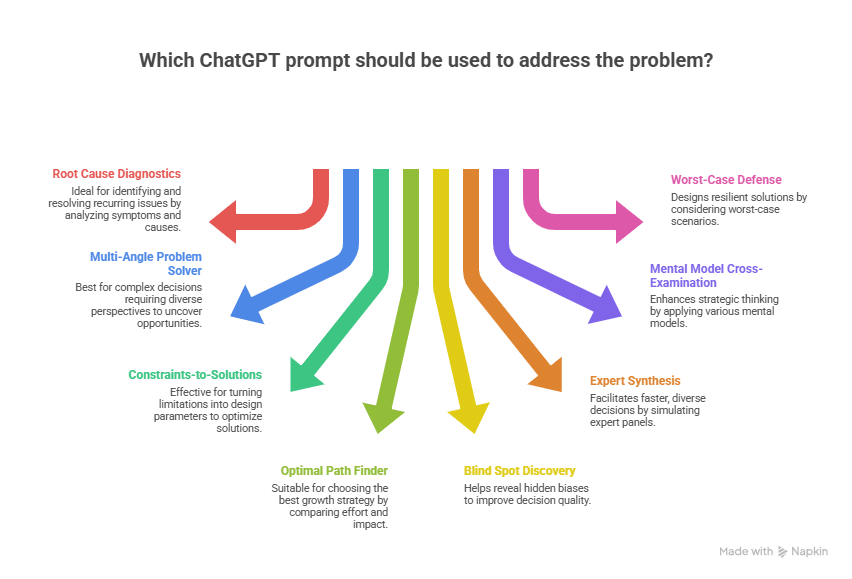
Root Cause Diagnostics Prompt
The Root Cause Diagnostics Prompt with ChatGPT helps find these reasons. It’s great for figuring out why projects are late.
“I want you to perform a root cause analysis on the following problem: [describe the problem]. First restate the problem in your own words to confirm understanding. Then identify all possible causes grouped into categories such as human factors, process factors, technical factors, environmental factors, and decision making factors. For each cause assign a likelihood rating from 1 to 10 and justify your reasoning. After listing all causes apply the Five Whys method to trace the most plausible root cause. Conclude with a structured summary including the highest probability root cause, the reasoning chain, and recommended next steps”
This prompt digs deep into the heart of issues affecting your projects or business. It uses a method that ChatGPT can help with. This method uncovers the complex reasons behind delays or inefficiencies.
Learn how to build your resume with ChatGPT!
Diagnosing Delays in Project Timelines
Imagine your team always misses deadlines. To find out why, use the Root Cause Diagnostics Prompt with ChatGPT. First, explain the problem and its context. ChatGPT will ask questions to find the root causes, like not enough resources or too tight timelines.
Using the Root Cause Diagnostics Prompt helps you fix problems at their source. It’s not just a quick fix. It also prepares you to avoid these problems in the future.
Multi-Angle Problem Solver Prompt
Complex business issues need a detailed look. ChatGPT can be a powerful tool for this. It helps by looking at problems from many sides, leading to better understanding and solutions.
“I need you to solve this problem from multiple perspectives: [describe problem]. First analyze it from a strategic perspective, then from an operational perspective, then from a financial perspective, then from a behavioral or human perspective, and finally from a systems perspective. For each perspective outline the constraints, opportunities, and friction points. Then synthesize all perspectives into a single integrated solution with justification for why it is optimal across domains. Present the final solution in a clear action oriented format.”
Looking at problems from different angles is key today. Cross-functional conflicts and tough decisions are common. This prompt lets you see all sides of a problem, making sure nothing is missed.
Read More: 7 Powerful Strategic Thinking Exercises To Use in 2026.
Solving Cross-Functional Conflicts Between Teams
Conflicts between teams can slow down a company. Using the Multi-Angle Problem Solver Prompt with ChatGPT helps break down these issues. It finds the main causes and solutions that might be hidden.
For example, when marketing and sales teams disagree, this prompt helps. It looks at the whole picture, not just one side. This way, you can find strategies that work for everyone.
To use the Multi-Angle Problem Solver Prompt well, do this:
- Clearly define the problem you’re facing.
- Identify the key stakeholders involved.
- Explore different scenarios and possible outcomes.
This method uses AI-assisted problem solving to boost your business strategy. It also helps in solving conflicts.
Constraints-to-Solutions Transformation Prompt
Turning constraints into opportunities is key for businesses under pressure. ChatGPT can help you turn challenges into solutions. It uses the Constraints-to-Solutions Transformation Prompt to find new ways to work around limits.
“Here is my problem: [describe problem]. First list all explicit and implicit constraints such as time, budget, skills, information gaps, and external dependencies. Then rewrite each constraint as a solvable design parameter. Next convert each parameter into at least two solution pathways. Evaluate all pathways in terms of simplicity, ROI, risk, and expected speed of results. Synthesize the top two solutions into one optimized plan and present a step by step execution path.”
Read More: Strategic Thinking for Startup Success.
Designing Solutions Under Budget and Time Pressure
Imagine your business has to cut costs and meet tight deadlines. You’re under a lot of pressure but have less to work with. ChatGPT can help find ways to save money and meet deadlines.
You can tell ChatGPT about your problems and ask for solutions. It will give you ideas for saving money and improving how you work. These ideas might surprise you.
Example Prompt: “Given our current budget constraints and tight deadline, suggest strategies to deliver our project on time without compromising quality.”
ChatGPT will offer practical ways to solve your problems. For example:
- Renegotiating contracts with suppliers to get better deals.
- Improving how you work to save time and money.
- Shifting resources to focus on what’s most important.
Using ChatGPT this way lets you use challenges as chances for growth and new ideas. It helps you deal with now and makes your business stronger for the future.
In short, the Constraints-to-Solutions Transformation Prompt is a great tool for businesses facing problems. By using ChatGPT, you can create plans that beat challenges and lead to success.
Optimal Path Finder Prompt
Finding the right growth strategy is key for businesses wanting to grow. In today’s world, strategic thinking is essential. The Optimal Path Finder Prompt helps businesses find the best way to grow.
“I want to achieve the following outcome: [describe goal]. Identify all possible ways to reach this outcome and cluster them into categories such as low effort paths, high leverage paths, long horizon strategies, short horizon tactics, and unconventional approaches. Compare all clusters on effort, expected outcome magnitude, probability of success, and time to results. Then choose one optimal path and turn it into a detailed roadmap with phases, milestones, KPIs, and risk mitigation tactics.”
This prompt uses ChatGPT’s analysis to look at different growth strategies. It considers market trends, customer needs, and competition. By using this prompt, you can understand your business better and make smart growth decisions.
Read More: Critical Thinking Techniques for Workplace Success.
Choosing the Best Growth Strategy for a Business
Imagine a business wanting to grow. They’re deciding between entering a new market or creating a new product. The Optimal Path Finder Prompt helps them decide by analyzing their data.
The analysis might show entering a new market is best. Or it could suggest making a new product. Either way, the prompt gives actionable insights for confident decisions.
Using the Optimal Path Finder Prompt helps businesses optimise their growth strategies. It’s useful for expanding into new markets or creating new products. This prompt is a valuable tool for strategic planning.
Blind Spot Discovery Prompt
Good leadership means making the right choices, without blind spots. As a leader, you face tough decisions. These can be swayed by unseen factors, like cognitive biases.
“Here is my situation or challenge: [describe context]. I want you to identify blind spots in my reasoning. Start by outlining the assumptions I am likely making. Then check these assumptions against typical cognitive biases and error patterns. Surface any information I may be overlooking and describe how this missing information affects the solution space. Conclude by offering an improved strategy or decision that incorporates the uncovered blind spots.”
ChatGPT’s Blind Spot Discovery Prompt helps you spot these hidden factors. It lets you understand what affects your decisions better. This way, you can make smarter choices.
Avoiding Leadership Decision Errors
The Blind Spot Discovery Prompt is key to avoiding bad decisions. Leaders make big choices with little info. Cognitive biases can mess up these decisions.
For example, you might choose a business strategy based on what you already think. You might ignore other good ideas. ChatGPT can offer a deeper look, showing blind spots and new ideas.
By using ChatGPT’s Blind Spot Discovery Prompt, you can:
- Spot biases that affect your choices.
- Understand all the factors in your decisions.
- Make better, less error-prone decisions.
Knowing your blind spots is key to good decision-making. ChatGPT helps you lead with confidence and clarity.
Expert Synthesis Prompt
ChatGPT’s Expert Synthesis Prompt helps make quick, smart decisions. It’s great for today’s fast business world. Being able to decide fast and well is key.
“I want you to act as a panel of experts to solve this problem: [describe problem]. Choose experts from relevant fields and name them along with their expertise. Have each expert provide their viewpoint in a structured paragraph that includes the issue analysis, recommended solution, and risks. Then synthesize all viewpoints into one high quality unified recommendation that integrates the strongest arguments. Present the final unified solution in a concise strategic plan.”
With this prompt, you can mix different views and skills. This makes your choices better. It makes deciding easier and more solid.
Making High-Impact Decisions Without Endless Meetings
Deciding big things can take too long. The Expert Synthesis Prompt fixes this. It gives a clear way to make decisions.
For example, when you need to decide something big, ChatGPT can help. You give it the facts and questions. Then, it makes a detailed report from what it knows.
The benefits of this approach include:
- Less time in meetings on the same topics.
- More expert views without a big group.
- Better choices because of different opinions.
Using the Expert Synthesis Prompt means you can decide faster and better. This helps your business succeed.
Mental Model Cross-Examination Prompt
Leaders need to solve problems well in today’s complex world. Making big decisions is part of their job. The Mental Model Cross-Examination Prompt helps challenge assumptions and improve strategic thinking.
“I want you to evaluate this problem using multiple mental models: [describe problem]. Apply the following mental models one by one: First Principles, Inversion, Second Order Thinking, Occam’s Razor, Pareto Principle, and Systems Thinking. For each model provide a short explanation of how it reframes my problem and what insights it generates. After applying all models synthesize the insights into one cohesive high quality solution and outline it in a clear action plan.”
This prompt makes you think deeply about your mental models. These are like frameworks that help you understand the world. By questioning these models, you can spot blind spots and improve your problem-solving skills. For more on mental models, check out mental models for a deeper dive.
Strategic Problem Solving for Leaders
Leaders can really benefit from this prompt when dealing with tough problems. It helps you understand challenges better and find better solutions. Here’s how:
- Identify and question your current mental models
- Look at other views and frameworks
- Use new insights in your decision-making
ChatGPT can help with this by letting you explore mental models and see how they fit your problems. This makes your strategic thinking better, leading to smarter decisions.
Using the Mental Model Cross-Examination Prompt helps leaders solve problems better. It makes decisions better and encourages learning and growth in the organisation.
Worst-Case Defense Architect Prompt
Thinking about the worst that could happen makes your business stronger. Risk is a big part of business life. So, having a good plan to deal with risks is key.
“Help me design a robust solution for this situation: [describe situation]. Begin by describing the worst realistic scenario that could happen if things go wrong. Then outline what would cause that worst case. Identify early warning signals and failure points. After that architect a defensive plan that prevents or mitigates failures before they happen. Finally present a resilient solution strategy that performs well even under stress and outline the actions required to implement it.”
ChatGPT can help a lot with this. It can help you make a detailed plan for managing risks. With the Worst-Case Defense Architect Prompt, you can spot dangers and plan how to avoid them.
Risk Planning for New Business Initiatives
New business ideas are full of unknowns. So, planning for risks is very important. ChatGPT can help you look at possible risks and plan for them.
Key Benefits of Using ChatGPT for Risk Planning:
- It helps find risks through careful analysis
- It helps make plans to reduce risks
- It makes your business ideas stronger
To use the Worst-Case Defense Architect Prompt well, first find out what risks your business might face. Look at both inside and outside factors that could affect your project.
For example, if you’re introducing a new product, risks could be market competition, supply chain problems, or changes in laws. Knowing these risks helps you plan how to deal with them.
ChatGPT can make a list of possible worst-case scenarios for you. This list helps you make a better plan to handle risks.
Best Practices for Implementing Worst-Case Defense Architect Prompt:
- Be clear about what you want to achieve in your risk planning
- Find out what risks are most important and what could go wrong
- Make specific plans to tackle each risk
Conclusion
When you use ChatGPT to solve business problems, see it as a tool to boost your thinking. It’s not just for quick answers. This way, you can improve your decision-making and judgment.
Augmenting Human Judgment
ChatGPT should help your strategic thinking, not take over. It adds AI insights to your human judgment. This helps you make better choices and avoid relying too much on AI.
Use ChatGPT to spark ideas, find blind spots, and explore scenarios. This way, you’ll make smarter decisions and grow your business. You’ll keep your critical thinking and judgment sharp.
The aim is to use AI wisely while keeping human insight and skills important. This balance lets ChatGPT help you achieve great results in your business.

Makarand S is a content writer who focuses on importance of soft skills and job readiness. Through his articles, He identifies potential gap areas and demonstrates easy and practical ways to overome them. With a keen interest in Skill Development, Makarand explores the shift in job landscapes and strategies for continuous learning. His articles help readers in preparing for the rapidly evolving nature of work more
Submit the form we will reply within Next 24 hours


Develop Must-Have Skills To Navigate Workplace Challenges And Build Executive Presence
Explore Topics
- AI-Driven Skill Development (7)
- Communication Skills in Indian English (12)
- Confidence Building for Students (5)
- Entrance Test Updates (2)
- Government Job Mindset Training (4)
- Lifelong Learning for Indian Women (3)
- Personality Development for IT/BPO (7)
- Public Speaking in Hindi/Marathi (1)
- Rural Empowerment via Soft Skills (0)
- Soft Skills for Indian Careers (11)
- Strategic Thinking for Entrepreneurs (29)
- text (0)
- Uncategorized (2)