Scale Your Business in 90 Days
Lorem ipsum dolor sit amet, consectetur adipiscing elit. Ut elit tellus, luctus nec ullamcorper mattis, pulvinar dapibus leo.
Lorem ipsum dolor sit amet, consectetur adipiscing elit. Ut elit tellus, luctus nec ullamcorper mattis, pulvinar dapibus leo.

TL;DR
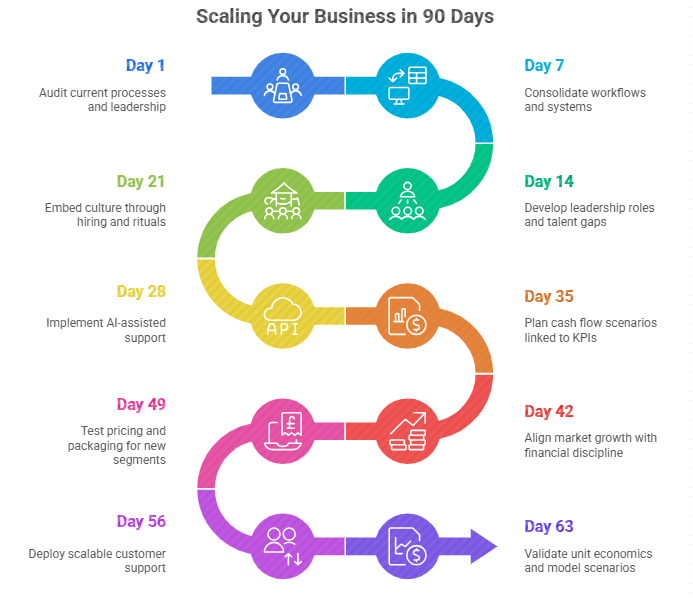
Scaling a business in 90 days needs strategic focus on audit, consolidation, and automation. Strong processes, clear leadership, and customer-first culture drive success. Manage cash flow via scenario planning. Smart use of AI supports growth while protecting customer experience.
Key Takeaways
- Early workflow formalization prevents operational debt.
- Develop leadership roles to close talent gaps.
- Embed culture through hiring and rituals.Use AI-assisted support to maintain customer satisfaction.
- Plan cash flow scenarios linked to KPIs (ARR, margin).
- This balanced approach aligns market growth with financial discipline for sustainable scale in 2025.
Introduction
When a business moves from experiment to expansion, the impact is organisational and personal. Founders, heads of operations and growth leads all notice the pressure as the company grows.Scaling a business brings new realities: systems must be stronger, leadership roles change and company culture needs deliberate care. Think of it like shifting from a fishing boat to a cargo ship. You need better infrastructure and a different crew.
This guide is aimed at SMEs, tech startups and scaleups (SaaS, fintech and product companies) navigating growth in both emerging and mature markets.
Challenges of Scaling a Business
- Challenges When Your Organisation Scales Up
Most leaders run into a few big roadblocks as their teams and goals grow. Did you know that over 70% of startups struggle to scale, and many fail because of people and process issues not just product or tech? - People and Leadership
Almost 70% of failures during growth come from issues with team structure, leadership, or hiring. Building strong middle management and clear roles is key, since 77% of companies say they have leadership gaps. - Sustainable Growth
Scaling too fast is why 74% of high-growth startups end up failing. Growing step by step, with good planning, helps a team avoid burnout and maintain quality. - Team & Culture
Hiring is tough, 40% of workers say rushed hiring during growth brings stress and makes people leave. Mentoring and smart onboarding can help keep your values alive as you grow. - Financial Management
Costs go up quickly with more people, tech, and compliance. Poor financial planning or overreliance on one funding source is a key cause of failure. - Operational Efficiency
Processes that work in a small team often break down with more people. Using standard procedures and tools for automation helps keep things running smoothly. - Customer Experience
Maintaining quality service gets harder as you scale. Companies that use strong playbooks, track KPIs, and invest in customer support see higher customer satisfaction. - Systems & Technology
Scaling demands upgrades in CRM, billing, and analytics. Disconnected tools can cause data chaosstreamlining tech early on saves money and stress later. - Market & Go-to-Market Shifts
As you reach new customers or regions, messages and pricing often need a refresh. - Compliance & Regulation
New markets mean new rules. Not hiring compliance experts is a top reason for costly delays. - Risk & Governance
Growing companies face more risks. A simple risk register and clear policies keep your team prepared. - Accountability & Execution
Every process should have one owner and at least three clear KPIs this boosts success and clarity. - Meetings & Time Use
Bigger teams need smarter meetings: daily for small groups, weekly for leaders, and monthly for company-wide goals. Protect time for strategy, not just daily tasks. - Capital Planning
Forecast costs and hiring, and use a mix of equity and other funding options to handle ups and downs. - Innovation & AI
Cloud-first, modular systems and smart AI tools can speed growth, but only if you manage data and risks well.
Also Read : Strategic Thinking in Business: Harvard Teaches VS Real Life
When scaling your business, focus on two linked clusters:
Market & Customers, and Finance & Growth they must move in step for sustainable expansion.
Market & Customers
Articulate a clear vision and a short-term growth plan that ties product bets to measurable customer outcomes that keeps teams aligned as the company grows.
Deepen your understanding of target segments and competitors. In emerging markets, local regulation and payment habits matter as much as product fit; in mature markets, differentiation and channel partnerships drive scale.Products and go-to-market: Test pricing and packaging for new segments (SMB midmarket enterprise).
A SaaS company moving to enterprise often needs a dedicated sales motion, contract/legal support and product customisation.Customer experience & feedback loops: Deploy scalable support (AIassisted triage, bot + human handover), NPS tracking and regular voice of customer reviews so you defend retention while acquiring new customers.
Finance & Growth
Business model and unit economics: Validate that unit economics (LTV:CAC, gross margin) improve at scale, and model scenarios for different growth rates so you understand capital needs and breakeven timing.
Financial management & capital planning: Prepare a three scenario forecast (base / upside / downside) covering hiring, infrastructure and marketing spend. Decide on capital mix early VC, growth debt or revenue finance based on dilution tolerance and speed requirements.
Costs, infrastructure and scalability: Budget for infrastructure (cloud, billing, analytics) and recurring costs.
Prioritise investments that unlock more customers or reduce unit costs rather than vanity spend.
Funding and investor relations: If you pursue capital, create a clear investor update rhythm and a concise plan showing how new capital will support customer growth, product development and operational resilience.
Also Read : 4 Step Solution to Scale a Business in 2026
Practical Tips for Scaling a business (90day starter)-

Days 1- 30: Audit and prioritise:
map the top 5 end-to-end processes (sales onboarding delivery support renewals). Identify duplication, tools that overlap and one high-impact process to simplify this quarter.
Days 31- 60 Consolidate and clarify:
Reduce the number of tools by replacing overlapping systems (example: consolidate two CRMs or move from manual spreadsheets to one billing platform). Clarify roles assign RACI owners for each process so staff know who is accountable.
Days 61- 90 Automate and standardise:
Automate repetitive tasks (email sequences, billing retries, reporting) and publish simple Standard Operating Procedures (SOPs). Train a small crossfunctional pod (37 people) to pilot the new flow and measure change in cycle time and error rate.
Also Read : 8 ChatGPT Prompts for Solving Complex Business Problems
Conclusion
Scaling a business successfully in 2025 requires early formalization of workflows to prevent operational debt, proactive management development to address talent gaps, and embedding company culture through consistent values-based hiring and rituals. Protecting customer experience with AI-assisted support is critical as headcount grows. Finally, managing cash flow through scenario-based capital planning linked to clear KPIs ensures sustainable growth in a dynamic market.
Frequently Asked Questions (FAQs)

Makarand S is a content writer who focuses on importance of soft skills and job readiness. Through his articles, He identifies potential gap areas and demonstrates easy and practical ways to overome them. With a keen interest in Skill Development, Makarand explores the shift in job landscapes and strategies for continuous learning. His articles help readers in preparing for the rapidly evolving nature of work more
Submit the form we will reply within Next 24 hours


Develop Must-Have Skills To Navigate Workplace Challenges And Build Executive Presence
Explore Topics
- AI-Driven Skill Development (7)
- Communication Skills in Indian English (12)
- Confidence Building for Students (5)
- Entrance Test Updates (2)
- Government Job Mindset Training (4)
- Lifelong Learning for Indian Women (3)
- Personality Development for IT/BPO (7)
- Public Speaking in Hindi/Marathi (1)
- Rural Empowerment via Soft Skills (0)
- Soft Skills for Indian Careers (11)
- Strategic Thinking for Entrepreneurs (29)
- text (0)
- Uncategorized (2)