Communication Skills for IT Professionals in 2026
Lorem ipsum dolor sit amet, consectetur adipiscing elit. Ut elit tellus, luctus nec ullamcorper mattis, pulvinar dapibus leo.
Lorem ipsum dolor sit amet, consectetur adipiscing elit. Ut elit tellus, luctus nec ullamcorper mattis, pulvinar dapibus leo.

TL;DR
By 2025, industry surveys predict that a majority of IT roles will demand advanced communication alongside technical expertise as a measurable part of job performance (see Gartner and LinkedIn skills reports).
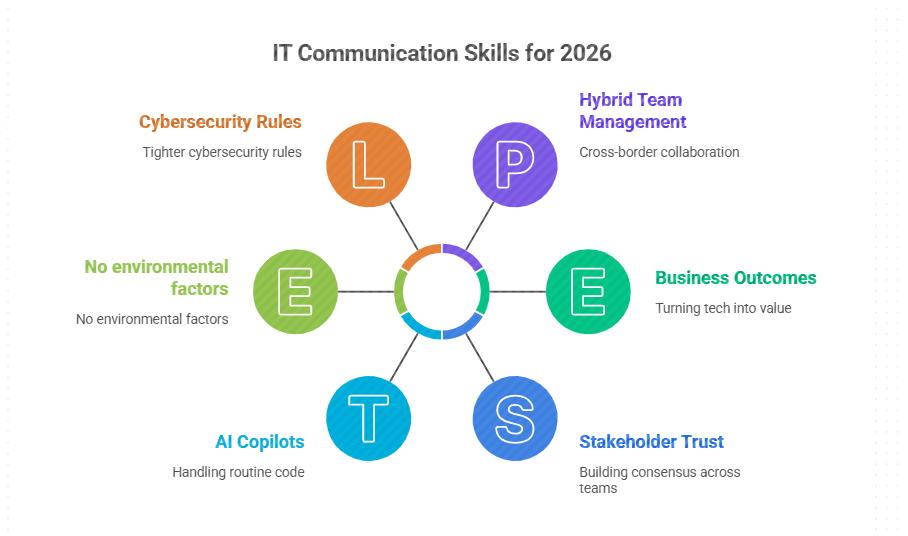
The rise of AI copilots, hybrid teams and tighter cybersecurity rules means that technical skills alone no longer guarantee impact.
Soft skills especially precise workplace communication, active listening and the ability to translate technical detail into business terms amplify technical output. They make projects run faster, reduce handover errors and speed stakeholder approvals.Investing time in these abilities turns raw technical work into business outcomes. This guide highlights the core soft skills to practise, shows practical 2025-era scenarios, and gives quick actions you can start today.
Key Takeaways
- Strong soft skills lift technical work into business impact think fewer escalations and faster approvals.
- Clear communication shortens incident resolution and improves stakeholder trust.
- AI and cloud trends make hybrid IT communication a core job skill in 2025.
- Practice active listening and data storytelling to bridge tech and non-tech teams.
- Use targeted training and role-play to make skills measurable and repeatable.
Introduction
Technical skills may get you the job, but human skills deliver the results. With AI copilots handling routine code and cloud platforms automating repeatable tasks, employers increasingly rank interpersonal skills and clear communication alongside technical competency.
Recent industry reports (Gartner and LinkedIn) highlight a persistent skills gap where companies struggle to find IT talent who can bridge technical detail and business priorities.That gap is not theoretical it affects hiring, promotion and project outcomes. Employers tell hiring teams they want candidates who can explain risk to executives, run cross-border hybrid teams, and write concise incident updates that non-technical stakeholders can act on.
Training programmes that pair technical upskilling with communication practice are becoming standard in forward-looking companies.
Also read :7 Steps to Improve Communication Skills in Customer Service
Increase hiring prospects and accelerate promotion
Soft skills In hybrid teams, the ability to communicate ideas clearly and collaborate across time zones raises your visibility. Recruiters and managers favour candidates who combine technical depth with the ability to influence decisions, which directly improves hiring odds and shortens promotion cycles.
Soft skills multiply technical value
In practice, teams that standardise concise incident briefings and one-page decision notes report fewer handover errors and faster approvals from non-technical stakeholders.
Invest in training that pairs technical drills with communication practice role-plays, table-top incident simulations and delivering presentations.
Also Read : Communication Skills for Business Development Success
Top Soft Skills for 2026
- Effective Communication:
The Key to CollaborationClear, concise communication prevents misunderstandings and speeds decision-making. In hybrid teams youll write fewer follow-up emails if your first update contains the problem, impact, next steps and ETA the PINE format (Problem, Impact, Next steps, ETA). - Organisation and Time Management for Multi-Project Work
Prioritisation and structure keep projects on track. Use a clear daily ritual (sync, prioritize, block time) and a shared backlog so hybrid teams avoid duplicated effort across time zones. - Analytical Thinking for Debugging and Trend Detection
Analytical thinking means turning data into a story that informs decisions. Break problems into hypotheses, test quickly, and present findings with two KPIs that matter to the audience (for example, MTTR and number of affected users) - Creativity for Novel Solutions and Product Ideas
Creativity in IT is not just design its finding ways to automate repetitive work, improving customer experience and inventing simple fixes that scale. Creative thinking often leads to measurable wins: faster onboarding, reduced tickets, or new automation that saves hours per week.
Interested in Soft Skills Read this : Soft Skills vs Hard Skills in Project Management
Soft Skills that Every IT Team Needs
As AI copilots, automation and hybrid teams become the norm, companies that pair technical training with communication practice outperform peers on delivery and stakeholder trust (see McKinsey on diversity & innovation and LinkedIn skills trends).
Below are practical scenarios showing how soft skills cut friction, speed decisions and produce measurable benefits.
Incident Communication with AI-Assisted Troubleshooting and Stakeholder Updates

Active listening during handovers, succinct written updates and data storytelling help non-technical stakeholders understand risk and approve actions quickly.
Teams that standardise concise incident briefings report fewer escalations and faster approvals.
Skills AI Can’t Replace
AI excels at pattern detection and drafting, but it cannot replace judgement, empathy, political awareness or negotiation. These human abilities are crucial when you must weigh competing priorities, build consensus across teams, or explain trade-offs to a CFO.
Practical focus areas: empathy in stakeholder conversations, negotiation in vendor management and judgement in prioritising security fixes vs. feature delivery.
Also Read : The Importance of Upskilling for Generative AI Roles in 2026
Author’s Takeaway
Staying ahead in IT means combining human strengths with AI tools. Strong soft skills clear workplace communication, stakeholder empathy and concise decision-making turn technical work into measurable business outcomes and make you far more valuable to employers.
Practical benefits: better hybrid IT communication shortens approval cycles, improves stakeholder trust and reduces rework. Pair targeted training with real practice and youll see results in reduced escalations and faster delivery.Empowering Your Career Growth.
3 steps to future-proof your IT career:
- Practice Storytelling:
prepare a one-slide summary with two KPIs for your next project update (measurement: shorter approval time).Join a 30-day training cycle that combines technical drills with communication role-plays (measurement: time-to-first-ticket or reduced MTTR). - Set a personal KPI for improvement:
(for example, reduce incident handover errors by X% in the next quarter) and review progress with your manager.Development resources: sign up for a short workshop that pairs technical labs with communication coaching, use tabletop exercises in team training, and adopt micro-training modules to make learning continuous.
The future belongs to IT professionals who develop both hard skills and soft skills in tech the ability to explain, persuade and build trust will keep you relevant and ready for the complex IT world ahead.
Also Read : Technical Communication as a Soft Skill
Frequently Asked Questions (FAQs)

Makarand S is a content writer who focuses on importance of soft skills and job readiness. Through his articles, He identifies potential gap areas and demonstrates easy and practical ways to overome them. With a keen interest in Skill Development, Makarand explores the shift in job landscapes and strategies for continuous learning. His articles help readers in preparing for the rapidly evolving nature of work more
Submit the form we will reply within Next 24 hours


Develop Must-Have Skills To Navigate Workplace Challenges And Build Executive Presence
Explore Topics
- AI-Driven Skill Development (7)
- Communication Skills in Indian English (12)
- Confidence Building for Students (5)
- Entrance Test Updates (2)
- Government Job Mindset Training (4)
- Lifelong Learning for Indian Women (3)
- Personality Development for IT/BPO (7)
- Public Speaking in Hindi/Marathi (1)
- Rural Empowerment via Soft Skills (0)
- Soft Skills for Indian Careers (11)
- Strategic Thinking for Entrepreneurs (29)
- text (0)
- Uncategorized (2)