How to crack CDS exam in first attempt
Learn the CDS exam pattern, create a CDS study plan, and boost your CDS exam preparation.
Introduction

Ready to clear the CDS on your first try? You need a clear path. Start with the syllabus. Know the papers set by UPSC. Focus on English, Maths and general knowledge. Use trusted books like NCERT and R.S. Aggarwal. Pair them with Lucent and S.P. Bakshi for quick wins.
Work smart. Practise past papers from 2014–2024. Take short mock tests to build speed and accuracy. Keep revision tight with short notes. Block 2 focused hours each day. Improve weak topics first. Track progress weekly.
Stay fit and focused. Sleep well. Walk or run daily. Keep motivation high. I’ll guide you step by step and share a simple study plan and realistic plan to boost your odds for UPSC CDS.
Also Read: Economics for SSC Exams Explained.
Key Takeaways
- Map the syllabus and break papers into small tasks.
- Use proven books and past papers to practise.
- Short, focused daily sessions beat long, distracted ones.
- Revise with active recall and spaced repetition.
- Maintain fitness and a steady routine for exam day.
Understand the CDS exam pattern
Understand what is asked and how marks are awarded before you study. This saves weeks of confusion. When you know the exam structure you can focus on scoring areas and avoid negative marking traps.
Papers, marks, timing and negative marking at a glance
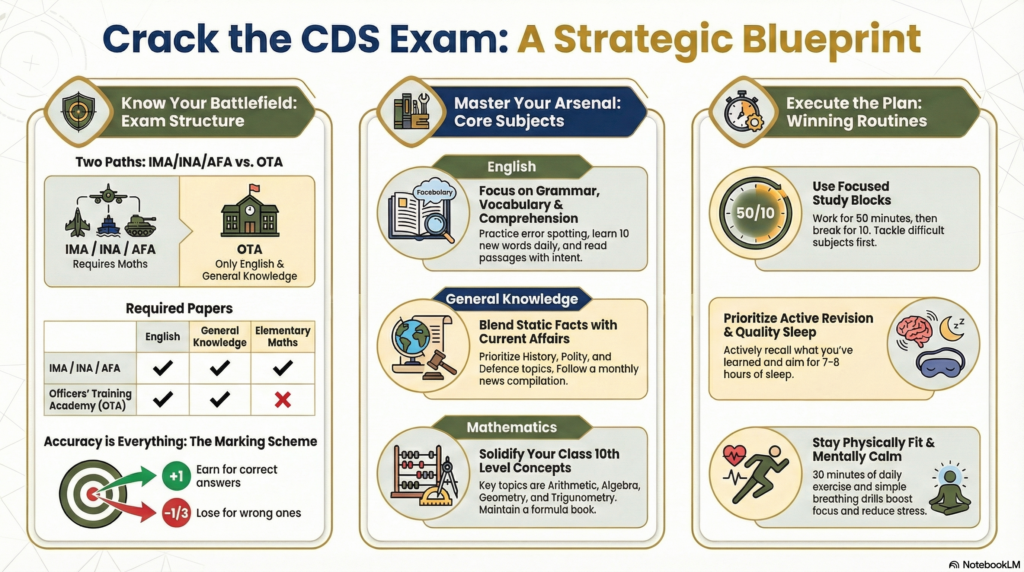
For Indian Military Academy, Indian Naval Academy and Air Force Academy there are three papers. Each paper is worth 100 marks. You get 100 objective questions in 2 hours per paper. Each correct answer gives +1 mark. Each wrong answer costs -1/3 mark. Accuracy beats blind guessing every time.
Officers’ Training Academy has two papers only. It covers English and General Knowledge. There is no Mathematics paper for OTA.
Also Read: How to Prepare for Nabard exam!
Differences between academies
- IMA / INA / AFA: English, General Knowledge and Elementary Mathematics. Maths is compulsory here.
- OTA: English and General Knowledge only. Choose subjects accordingly from day one.
- Target recent cut-offs. Written trends show around 90–100 per paper and 130–150 aggregate for IMA/INA/AFA. OTA often needs 70–80 per paper and 100–120 aggregate.
Topic-wise syllabus mapping
English checks grammar, vocabulary and comprehension. Expect error spotting, cloze tests and passages.
General Knowledge mixes static and current topics. Focus on History, Geography, Polity, Science, Defence and recent national events of the past year.
Mathematics tests Class 10 level areas. Key topics: Arithmetic, Algebra, Geometry, Trigonometry, Mensuration and basic Statistics.
Action step: Decide your target academy now. Print the official syllabus page. Circle high-weight topics and start with them this week.
Trusted books, PYQs and mock tests
You need a shortlist of dependable resources. Start with NCERT Maths (classes 8–10) for strong basics. Add R.S. Aggarwal for chapter-wise practice. For English, use Objective General English by S.P. Bakshi. Use Lucent’s General Knowledge for static topics.
Solve previous year papers year-wise. Work through Oswaal and Arihant compilations. Track topic frequency and build a short revision list from repeated questions.
- Read one editorial daily to boost reading and comprehension.
- Do timed sets. Treat each set as a mini test and record time per question.
- Keep an errors log. Jot the concept missed and the corrected method.
- Mix topic drills with full-length mock tests for speed and stamina.
Buy one good test series and finish it. Depth beats many half-used options. Action step: pick one Maths book, one English book, one GK book and attempt 30 timed questions from a previous year paper today.
master English, GK and Mathematics
Master concepts with short, focused drills. Break sessions by subject. Work on weak topics first. Build accuracy through repeated, timed practice.
English: grammar, vocabulary, comprehension and error-spotting
Start with rules. Drill grammar from S.P. Bakshi. Solve 20 error-spotting questions daily. Review the rule the same evening.
Grow vocabulary. Learn ten words a day. Use each word in two sentences. Retest on weekends to aid revision.
Read with intent. Two passages a day improves comprehension and speed. Focus on inference and tone. Try one editorial and one short technical brief.
General Knowledge: static + current affairs routine
Static first. Current at night. Use Lucent for facts. Read PIB briefs and a monthly compilation for current affairs.
Map high-yield topics. Modern History, Polity, Geography and defence programmes come up often. Make short notes and revise weekly.
Mathematics: block-based practice and formula recall
Follow blocks. Start with Arithmetic and Algebra. Move to Geometry and Trigonometry. Finish Mensuration and Statistics.
Keep a formula book. One page per chapter. Re-write identities and key methods before every mock.
Accuracy over guesswork
- Attempt sure-shot questions first.
- Mark doubtful ones for a second pass.
- For every mistake, note the concept gap and re-solve three similar questions.
Action step: Try a 60-60-60 session today. One hour each for English, general knowledge and Maths. Log what you learn and one question you could not answer.
Daily routine, time management and revision tactics for first-attempt success
A tight, daily routine turns small hours into steady gains. Time is your lever. Two to three focused hours each day, used well, provide the returns toppers report from cities like Bengaluru and Hyderabad.
Designing a practical timetable around 2–3 focused hours
Use short blocks. Work 50 minutes. Break 10 minutes. Repeat. No multitasking. Frontload hard topics like maths or grammar first. Finish with lighter reading or general knowledge.
Protect sleep. Aim for seven hours. A fresh mind reads faster and makes fewer mistakes.
Active recall, spaced repetition and short notes for quick revision
Close the book. Write what you remember. Check gaps. Fix them. Spend 15 minutes each day revising formulas, word lists and key facts.
- Space reviews: Day 1, Day 3, Day 7, Day 14.
- Keep one-page summaries per chapter for quick checks on commutes.
- Track mistakes. Note the trigger and correct the root cause.
Action step: Draft a seven-day timetable now. Use two 60-minute focused blocks and one 30-minute review block each day. Start today and measure progress weekly.
Also Read: Why Mastering Strategic Thinking Can Increase Your Exam Scores?
Stay fit, focused and motivated through the preparation journey
A steady body and a calm mind amplify every hour you spend on revision. Build habits that support SSB readiness and written performance. Small, daily actions beat last-minute rushes.
Physical fitness and habit-building for SSB readiness
Move daily. Do 20–30 minutes of running or brisk walking. Add push-ups, squats and planks for core strength.
Train for the SSB early. Work on stamina, posture and simple team tasks. Fitness helps focus during long practice sessions.
Mental resilience: stress control, sleep hygiene and consistency
Protect sleep. Aim for 7–8 hours. Your recall and speed rise with rest.
Keep breathing drills. Five minutes morning and night reduces stress. Short meditation helps on high-pressure days.
Avoiding common mistakes: over-guessing, ignoring weak areas, last-week cramming
Respect negative marking. Skip what you can’t solve cleanly. Over-guessing drains marks.
Don’t neglect weak topics. Give them 15 focused minutes daily. Small wins build confidence over the year.
No last-week cramming. Use that time for mocks, formula sheets and light revision.
- Keep current affairs light and steady. 30 minutes daily using PIB and a monthly compilation.
- Train for naval academy or air force assessments with targeted runs and mobility work.
- Balance practice and rest. Track time and avoid burnout.
Action step: Fix a daily fitness slot and a 30-minute daily current affairs window. Start tonight.
Also Read : How to crack NEET in one year? Use our smart study routine
Conclusion
Lock a target date, then shape four weeks of focused practice around it.
Keep your routine tight. Use core books — R.S. Aggarwal, S.P. Bakshi and Lucent — and solve previous year papers from 2014–2024. Treat each written paper as a 100 marks test. Time each paper for two hours and respect the negative marks.
Do two timed mock tests a week. Track errors. Fix concepts fast. Use one-page notes for quick revision. Read a short daily current affairs brief. Balance English, general knowledge and maths by your academy target — Indian Military Academy or Indian Naval Academy.
You can crack upsc cds on your first try. Set your calendar now. Lock the next four weeks with daily tasks and two tests per week.
Frequently Asked Questions

Makarand S is a content writer who focuses on importance of soft skills and job readiness. Through his articles, He identifies potential gap areas and demonstrates easy and practical ways to overome them. With a keen interest in Skill Development, Makarand explores the shift in job landscapes and strategies for continuous learning. His articles help readers in preparing for the rapidly evolving nature of work more
Submit the form we will reply within Next 24 hours


Develop Must-Have Skills To Navigate Workplace Challenges And Build Executive Presence
Explore Topics
- AI-Driven Skill Development (7)
- Communication Skills in Indian English (12)
- Confidence Building for Students (5)
- Entrance Test Updates (2)
- Government Job Mindset Training (4)
- Lifelong Learning for Indian Women (3)
- Personality Development for IT/BPO (7)
- Public Speaking in Hindi/Marathi (1)
- Soft Skills for Indian Careers (11)
- Strategic Thinking for Entrepreneurs (29)
- Uncategorized (2)