Mastering Public Speaking with NLP: Practical Techniques for Real Impact

Lorem ipsum dolor sit amet, consectetur adipiscing elit. Ut elit tellus, luctus nec ullamcorper mattis, pulvinar dapibus leo.
Lorem ipsum dolor sit amet, consectetur adipiscing elit. Ut elit tellus, luctus nec ullamcorper mattis, pulvinar dapibus leo.
Mastering Public Speaking with NLP: Practical Techniques for Real Impact
Key Takeaways
- Start with a short, vivid story your audience can see, hear, or feelthis creates instant engagement.
- Your body speaks louder than your words.
- Rhetorical and leading questions pull the audience into the talk even when they arent speaking.
- Concise speaking makes ideas easier to remember.
- Slow down and let ideas land.
Introduction
Did you ever go blank at the start of a presentation?
Neuro-Linguistic Programming (NLP) is a practical tool for simple ways to shape how people receive your message.This article is useful for people who want to improve in public speaking.
You’ll find quick drills, examples from TEDx and startup pitches, and clear explanations of how to use NLP ideas like sensory language and confidence triggers without technical jargon. I’ll also flag where claims are practical coaching tips rather than settled science, and point to research where useful.
Engaging the Audience:
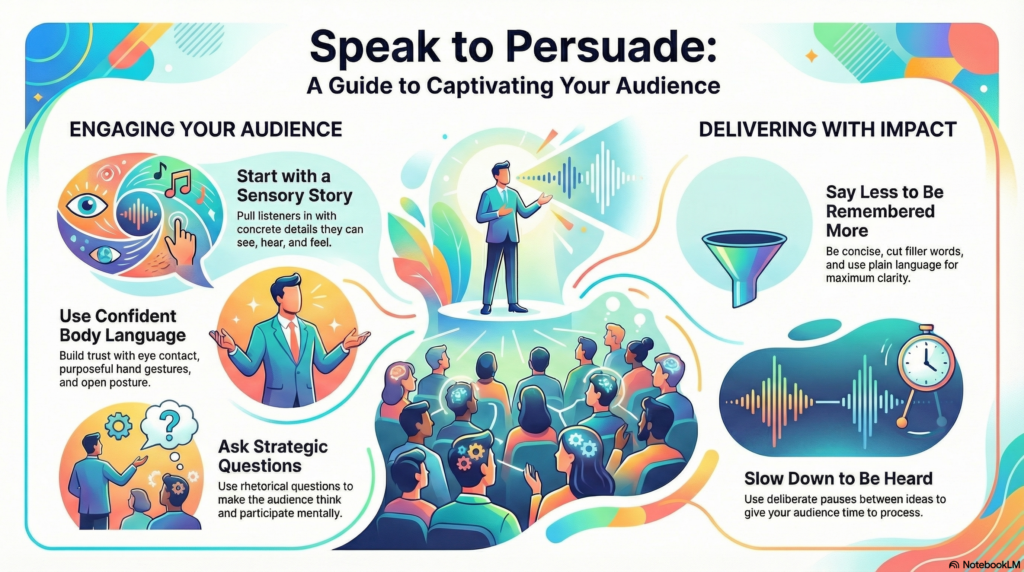
Start with a short, sensory story that pulls people into a moment. Use concrete details for listeners to see, hear and feel the moment:( Tell them what you saw, a sound that you heard, a small physical sensation you felt). In NLP terms this is known as association; in plain language its using sensory words to make your point stick.
Keep Their Attention:
Once you’ve captured their attention, look people in the eye long enough to be noticed, use hand gestures that mirror your words, and move on stage with purpose rather than pacing nervously.
Positive, open body language signals confidence and helps people trust you which is the foundation of effective public speaking.
Act out key phrases with your hands
By showing visual movement helps the visual thinkers in the room follow your idea. Don’t overdo it; gestures should underline meaning, not distract from it. Practise in front of a phone camera..
Invite Thinking with Questions
Questions are one of the simplest tools to involve the audience. Use rhetorical questions to prompt imagination (What if you woke up tomorrow and your biggest problem was solved?) and leading questions to guide thinking toward your conclusion (Wouldn’t that free up time for more creative work?). Strategic questions make your audience mentally participate even when they’re silent.
Also Read: Beat Public Speaking Anxiety in 10 steps!
Say Less, Remember More
Less really is more in public speaking. Being concise doesn’t mean skimming the important stuff, it means choosing the clearest words and delivering them with intention so your audience understands and remembers.
Cut tangents, replace filler words like um and like with purposeful pauses, and favour plain language over unnecessary technical detail. Clear, economical speaking is one of the fastest ways to improve your results on stage or in a pitch meeting.
Slow Down to Be Heard
Speaking too fast undermines comprehension. Use brief, deliberate pauses between ideas they give your audience time to process and make your statements land with more force. Record a short segment and deliberately insert a two second pause after each main idea; listen back and note how meaning sharpens.
Also Read: 6 Steps to Boost Your Confidence and Unlock Your Potential.
Conclusion
Public speaking isn’t about sounding perfect; it’s about making your message land. NLP gives you a set of practical tools to achieve that. Sensory language helps your audience picture your ideas. Purposeful movement, open body language, and well-timed pauses make your delivery feel controlled instead of rushed.
Remember, none of these skills requires advanced training, just focused and consistent practice.
Start applying one technique from this article today. With repetition, these skills become automatic, and youll find yourself speaking with more confidence, control, and real impact.

Makarand S is a content writer who focuses on importance of soft skills and job readiness. Through his articles, He identifies potential gap areas and demonstrates easy and practical ways to overome them. With a keen interest in Skill Development, Makarand explores the shift in job landscapes and strategies for continuous learning. His articles help readers in preparing for the rapidly evolving nature of work more
Submit the form we will reply within Next 24 hours


Develop Must-Have Skills To Navigate Workplace Challenges And Build Executive Presence
Explore Topics
- AI-Driven Skill Development (7)
- Communication Skills in Indian English (12)
- Confidence Building for Students (5)
- Entrance Test Updates (2)
- Government Job Mindset Training (4)
- Lifelong Learning for Indian Women (3)
- Personality Development for IT/BPO (7)
- Public Speaking in Hindi/Marathi (1)
- Rural Empowerment via Soft Skills (0)
- Soft Skills for Indian Careers (11)
- Strategic Thinking for Entrepreneurs (29)
- text (0)
- Uncategorized (2)