JEE 2026 Preparation: 7 Powerful Strategies for Success
To stand out among 16 lakh JEE students, you need a smart strategy.
Introduction
Are you aiming for JEE2026 success? You’re not alone. About 16 lakh students will face the toughest exam yet. To stand out, you need a smart strategy, not just hard work.
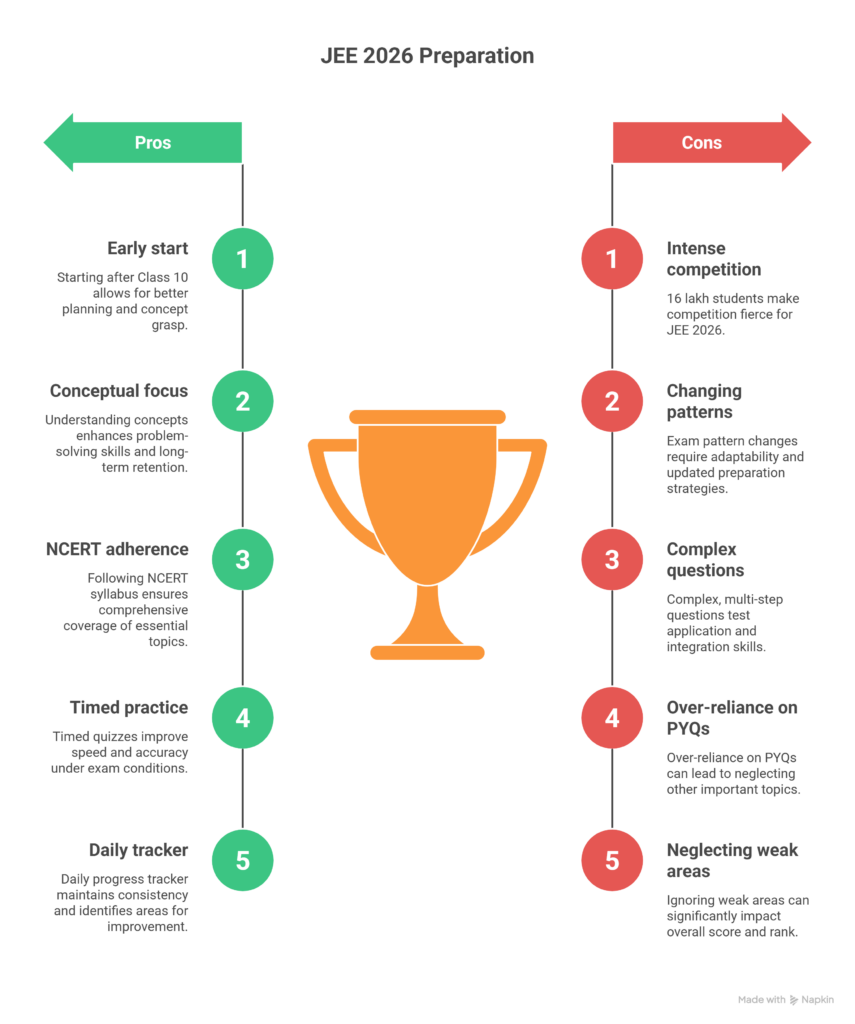
Preparing for JEE2026 requires a strategic plan. The competition is getting fiercer, and the exam patterns are changing. Top rankers say start early, keep a steady study schedule, and focus on understanding concepts, not just memorizing.
For a winning JEE Main strategy, stick to the NCERT syllabus for Physics, Chemistry, and Mathematics. Also, be ready for more complex, multi-step problems.
TL;DR
- Over 16 lakh students will attempt the toughest JEE yet success needs smart, strategic study.
- January & April sessions, mandatory Section B NVQs (20MCQs + 5NVQs per subject), greater focus on conceptual + application-based questions.
- Topper strategies: Start right after Class 10, follow the 5:7:8 subject ratio (Physics:Chemistry:Math), and balance theory vs. problem-solving at 60:40.
- Use a daily progress tracker, mix MCQs with NVQs in regular timed practice, and analyse mistakes after mock tests.
- Subject focus :Physics conceptual clarity + timed problem practice.
- To crack JEE, focus on Physics with conceptual clarity and timed problem practice, master Chemistry through NCERT first before moving to advanced practice, and build Math skills with speed, accuracy, and smart shortcuts.
- Avoid over-relying on PYQs, skipping NCERT, or ignoring weak areas; keep motivation high with achievable daily goals.
Key Takeaways
- Start early and maintain a consistent study schedule.
- Focus on conceptual clarity, not just memorization.
- Follow the NCERT syllabus for Physics, Chemistry, and Mathematics.
- Practice with previous years’ papers and mock tests.
- Use a proven study plan and Daily Progress Tracker.
Why JEE 2026 is Tougher Than Ever
The JEE2026 exam is coming, and it’s important to know what’s new and challenging.
The JEE Main and Advanced exams are changing. Aspirants need to understand these changes to prepare well.Questions in JEE2026 are getting harder every year. It’s predicted to be the toughest yet.
The questions will test your knowledge, application, and integration skills.
Also read : How to crack NEET in one year? Use our smart study routine
Exam Structure Overview
The JEE2026 exam will have two sessions: January and April. It will cover Physics, Chemistry, and Mathematics from NCERT syllabus for Classes 11 and 12. Knowing the exam structure is essential for good preparation.
Here’s what you can expect in the JEE 2026 exam:
| Exam Session | Syllabus | Subjects |
| January & April 2026 | NCERT, Classes 11–12 | Physics, Chemistry, Math |
For more insights on the difficulty level of JEE Advanced, you can visit this link to understand the challenges better.
JEE 2026 Paper Pattern Explained
The Joint Entrance Examination (JEE) Main 2026 has made big changes. These changes will affect how students prepare for the exam.
Mandatory Section B Questions
In Numerical Value Questions (NVQs) in Section B. No more optional questions;
Now, candidates must answer all 5 NVQs per subject. This means students need to work on both multiple-choice questions and numerical problems.
Exam Composition
The JEE2026 exam will have 20 Multiple Choice Questions (MCQs) and 5 NVQs per subject.
The subjects are Physics, Chemistry, and Mathematics. Regular candidates have 3 hours, while PwD candidates get 4 hours to finish the exam.
- Physics: 20 MCQs + 5 NVQs
- Chemistry: 20 MCQs + 5 NVQs
- Mathematics: 20 MCQs + 5 NVQs
What Sets 2026 Apart
The JEE2026 exam focuses on conceptual depth and multi-step problem-solving. Students need to understand concepts well and solve complex problems to do well.
Preparing for the exam requires a smart plan. We suggest that students:
- Build a strong foundation in concepts
- Practice with a mix of MCQs and NVQs regularly
- Work on solving problems quickly
Secret Study Plan
What Top Rankers Are Doing Differently.
Start Right After Class 10
We suggest starting JEE prep after Class 10. This lets you make a detailed plan for the big syllabus. Early start means no cramming and better concept grasp.
To make a good plan, know your strong and weak areas in each subject. Spend more time on weak spots but keep up your strong ones too.
The 5:7:8 Subject Ratio: A Proven Strategy
A good strategy is the 5:7:8 subject ratio. Spend 5 parts on Physics, 7 on Chemistry, and 8 on Mathematics each week. This helps because Math is often harder.
This ratio helps you study all subjects well. For example, if you study 20 hours a week, use 5 hours for Physics, 7 for Chemistry, and 8 for Math.
Use a Daily Progress Tracker: Staying on Track
A daily progress tracker is great for keeping track. It logs date, topic, hours studied, tests, and your progress notes.
With a tracker, you can see where to focus more and tweak your plan. It keeps you consistent and stops procrastination. For a detailed routine, check topper’s daily routine for JEE success.
Also read : How Ethics (GS Paper IV) Can Be Your Highest Scoring Paper
Build Theory + Application Together (60:40 Ratio)
To ace JEE2026, mix learning theory with solving problems. Spend 60% of your time on theory and 40% on practice. This balance is key.
Understand First, Then Solve Problems
Get the theory down before you start solving problems. This method boosts your memory and problem-solving skills. As a top student once noted,
Create Your Daily Study Schedule
Make a daily plan that matches the 60:40 ratio. Here’s a simple example:
| Time | Subject | Theory/Application |
| 8:00-9:00 AM | Physics | Theory (60%) |
| 9:00-10:30 AM | Physics | Application (40%) |
| 10:30-11:30 AM | Chemistry | Theory (60%) |
| 11:30 AM-1:00 PM | Chemistry | Application (40%) |
Subject-Wise Secret Weapons
A guide to tackle Physics, Chemistry, and Mathematics well.
Physics: Conceptual Balance + Timed Practice
Physics needs a mix of conceptual balance and timed practice. It’s not just about formulas. You must apply them in exams. Start with solid concept knowledge, then practice many problems quickly.
To do well, try this:
- Practice daily with easy and hard problems.
- Do timed quizzes to get used to exams.
- Keep reviewing and revising concepts.
Chemistry: NCERT is The King
Read each chapter carefully and make sure you truly understand every concept, definition, and reaction. Keep revisiting the content until you can recall it confidently.
Then, strengthen your grip by solving all NCERT exercises and exemplar problems. Once youre comfortable, move on to additional question sets from other trusted books to apply what youve learned in different problem formats.
Mathematics: Speed, Accuracy, and Smart Shortcuts
In Mathematics, focus on speed, accuracy, and smart shortcuts. Practice many problems to get better. Learning shortcuts can also save time in the exam.
| Topic | Strategy | Tips |
| Algebra | Practice equations and inequalities. | Use shortcut formulas for solving equations. |
| Calculus | Focus on differentiation and integration. | Practice problems involving maxima and minima. |
| Geometry | Understand properties of shapes. | Use theorems to solve problems quickly. |
Best Study Resources
Choosing the right study materials is key to your JEE2026 prep. With many options, picking the best ones is vital.
Physics
For Physics, start with H.C. Verma. His books are known for clear explanations and covering all concepts. For practice, D.C. Pandey offers a wide range of problems to master the subject.
Also read : Improve Communication Skills for UPSC Interview Preparation
Chemistry
In Chemistry, NCERT textbooks are essential. They give a deep understanding of the subject. For Inorganic Chemistry, J.D. Lee is recommended. For Organic Chemistry, MS Chauhan provides detailed explanations and practice problems.
Mathematics
For Mathematics, Cengage is great for advanced problems. R.D. Sharma offers a solid foundation. Practicing with these resources boosts problem-solving skills and confidence.
Here’s a summary of the recommended study resources:
- Physics: H.C. Verma, D.C. Pandey
- Chemistry: NCERT, J.D. Lee, MS Chauhan
- Mathematics: Cengage, R.D. Sharma
Avoiding Common Pitfalls
Preparing for JEE2026 is tough. We must avoid common mistakes to do well. Knowing these pitfalls helps us prepare better and reach our goals.
Don’t Over-Rely on PYQs
Too much focus on past year questions (PYQs) is a big mistake. While they’re important, don’t just rely on them.
Use online tools to find questions and tests for practice.
Don’t Fall for Shortcut Videos: Understand Concepts
Shortcut videos might look good, but they’re not always helpful. It’s important to understand the basics first.
Getting the concepts right is essential for JEE success.
Don’t Neglect Weak Areas
Improving weak spots is critical for good scores. Ignoring them can hurt your overall score.
You can tackle weak area, using the following way:
- Check our performance often to spot weak spots.
- Make a plan to focus on these areas.
Also read : How to Prepare for UPSC Prelims in One Year?
Conclusion
As we wrap up our JEE2026 prep, staying motivated and focused is key. With hard work, the right plan, and a positive outlook, we can reach our goals.
We’ve discovered that success in JEE2026 means more than just memorizing. It’s about understanding and applying what we learn. By following the 5:7:8 subject ratio and using daily trackers, we’re on track to get a good rank.
Let’s keep our commitment strong, stay positive, and believe in ourselves. With the right jee motivation and final tips, we can beat any obstacle and make our dreams come true. Our conclusion is that with determination and the right strategy, we can do great in JEE2026.
Frequently Asked Questions (FAQs)

Makarand S is a content writer who focuses on importance of soft skills and job readiness. Through his articles, He identifies potential gap areas and demonstrates easy and practical ways to overome them. With a keen interest in Skill Development, Makarand explores the shift in job landscapes and strategies for continuous learning. His articles help readers in preparing for the rapidly evolving nature of work more
Submit the form we will reply within Next 24 hours


Develop Must-Have Skills To Navigate Workplace Challenges And Build Executive Presence
Explore Topics
- AI-Driven Skill Development (7)
- Communication Skills in Indian English (12)
- Confidence Building for Students (5)
- Entrance Test Updates (2)
- Government Job Mindset Training (4)
- Lifelong Learning for Indian Women (3)
- Personality Development for IT/BPO (7)
- Public Speaking in Hindi/Marathi (1)
- Rural Empowerment via Soft Skills (0)
- Soft Skills for Indian Careers (11)
- Strategic Thinking for Entrepreneurs (29)
- text (0)
- Uncategorized (2)