
Master Your Voice for Career Success in India 2026

Key Takeaways
- Mastering voice modulation is key for career success.
- Your voice shows confidence, clarity, and professionalism.
- Good voice modulation boosts your personal brand.
- It’s vital to work on your tone, pace, and pitch.
- A strong voice leaves a lasting impression in work settings.
The Hidden Power of Voice in Personal Branding
Your voice is more than just a sound; it’s a powerful tool in personal branding. It can make or break your professional image. Understanding how your voice impacts your professional presence is key in career development.
Let’s look at how voice shapes our professional image. It starts with how others perceive us. Your voice is often the first thing people notice, and it greatly affects how they receive your message.
Also Read: How Do Most Indian Students Fund Their Study Abroad Dream?
How Voice Shapes Perception
The tone of your voice can show confidence, authority, and enthusiasm. Or, it can suggest hesitation, lack of confidence, and disinterest. Tone > Content initially, as your voice signals your mindset and impacts trust. For example, a study found that a lower pitch is seen as more authoritative, while a monotone voice can make listeners less engaged.
Research shows that our voice tone greatly affects how our message is seen. A modulated voice can show emotion and emphasis, making our communication more effective. We can use this by being mindful of our voice tone in professional settings.
The Science Behind Voice and Credibility
The science behind voice and credibility is fascinating. For instance, a lower pitch is often seen as more authoritative, while a monotone delivery can make listeners less engaged. Knowing these dynamics can help you adjust your voice to boost your credibility.
Also Read: Use 4 Communication Techniques to Practice Assertive Communication At Workplace
Voice as a Career Differentiator
In a competitive job market, a clear and assertive voice can set you apart. Clarity is more important than fluency, as it shows confidence and authority. Being soft-spoken might seem unsure, but an assertive tone is linked to career advancement. By focusing on developing a strong, clear voice, you can improve your career prospects.
As we move towards 2026, voice technology will play a bigger role in personal branding. Mastering your voice will be key. With AI-driven voice tools supporting coaching and mentoring, the opportunities for growth are vast.
How to Improve Your Voice for Public Speaking: The Fundamentals
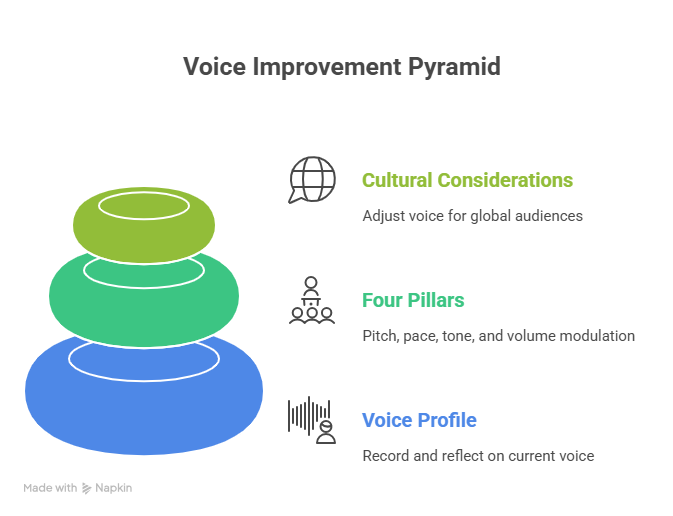
Improving your voice for public speaking is key. Start by understanding your voice and then work on the basics. These basics are what make your speaking effective.
Understanding Your Current Voice Profile
To improve your voice, first, know what it sounds like now. Record yourself and think about your pitch, pace, tone, and volume. Recording and reflecting on your speech shows you what to work on.
- Record yourself speaking on a topic you’re passionate about.
- Check your pitch and pace: Are you speaking too quickly or slowly?
- Conduct a clarity test: Can listeners understand you clearly?
Knowing your voice’s current state helps you focus your improvement. For more tips on public speaking, check out Harvard’s Professional Development blog.
The Four Pillars: Pitch, Pace, Tone, and Volume
The four pillars of voice modulation are key for good public speaking. They work together to make your message clear and engaging.
- Pitch: A lower pitch can sound authoritative, but mix it up to keep your audience interested.
- Pace: Speak at a pace that’s easy for your audience to follow.
- Tone: Your tone shows emotion and emphasis, adding depth to your words.
- Volume: Change your volume to highlight key points and keep your audience focused.
Also Read: 7 Steps to Improve Communication Skills in Customer Service!
Cultural Considerations in Global Settings
In global settings, cultural differences in communication are important. Direct vs. indirect tone can greatly affect how your message is seen.
- In some cultures, a direct tone is valued for its clarity and efficiency.
- In other cultures, an indirect tone is preferred for its politeness and respect.
- Volume and enthusiasm can be seen differently across cultures.
- Emotion in voice can be a powerful tool, but its expression varies culturally.
Knowing these cultural differences helps you adjust your voice for your audience. This makes you a more effective communicator worldwide.
Also Read: Cross-Cultural Communication: Strategies for a Global Workplace
Daily Voice Training Exercises for Lasting Improvement
To master your voice, daily exercises are key. They help you shine in presentations, interviews, and online meetings. Regular practice boosts your communication skills, making you more confident and effective.
5-Minute Morning Warm-up Routines
Starting your day with a voice warm-up is a game-changer. Here are simple exercises for your morning routine:
- Body & Breath Reset: Start with deep breathing to relax and prepare your voice.
- Lip Trills or Humming: Do lip trills or humming to loosen up your articulatory muscles and get your voice ready.
- Pitch Glides: Perform pitch glides to warm up your vocal cords and improve your vocal range.
- Articulation Drill: Practice articulation by repeating tongue twisters or simple phrases to enhance clarity.
Breath Control Techniques
Good breath control is key for a strong, confident voice. Try these techniques to improve your breathing:
- Box Breathing: Practice box breathing to regulate your breath and calm your nerves.
- Controlled Exhale Speaking: Focus on controlled exhale speaking to maintain a steady flow of words.
- Straw Phonation: Use straw phonation to improve your lung capacity and control.
- Paced Reading Practice: Engage in paced reading to practice sustained speech and breath control.
For more detailed guidance on voice training, check out Toastmasters’ guide on your speaking voice.
Conclusion: Your Voice, Your Future in 2026 and Beyond
As we move forward in our careers, knowing how to communicate well is key. Your voice can greatly affect how others see you and open up new chances. By 2026, being able to speak clearly and confidently will be more important than ever.
Your voice is a big part of who you are at work. It helps you lead, connect with others, and share your ideas clearly. By working on your voice every day, you can improve how you sound and look to others. For tips on improving your voice and professional image, check out Virtual Speech.
Keep working on your voice to reach your career goals. Your voice is a powerful tool that can make you stand out and build strong bonds with your team and clients.
Frequently Asked Questions (FAQs)

Makarand S is a content writer who focuses on importance of soft skills and job readiness. Through his articles, He identifies potential gap areas and demonstrates easy and practical ways to overome them. With a keen interest in Skill Development, Makarand explores the shift in job landscapes and strategies for continuous learning. His articles help readers in preparing for the rapidly evolving nature of work more
Submit the form we will reply within Next 24 hours


Develop Must-Have Skills To Navigate Workplace Challenges And Build Executive Presence
Explore Topics
- AI-Driven Skill Development (7)
- Communication Skills in Indian English (12)
- Confidence Building for Students (5)
- Entrance Test Updates (2)
- Government Job Mindset Training (4)
- Lifelong Learning for Indian Women (3)
- Personality Development for IT/BPO (7)
- Public Speaking in Hindi/Marathi (1)
- Soft Skills for Indian Careers (11)
- Strategic Thinking for Entrepreneurs (29)
- Uncategorized (2)