Global Startup Ecosystems 2026: Rankings, and Tech Trends to Watch
Lorem ipsum dolor sit amet, consectetur adipiscing elit. Ut elit tellus, luctus nec ullamcorper mattis, pulvinar dapibus leo.
Lorem ipsum dolor sit amet, consectetur adipiscing elit. Ut elit tellus, luctus nec ullamcorper mattis, pulvinar dapibus leo.

TL;DR
The world’s most innovative startup hubs are on the move, driven by cutting-edge tech trends. The latest Global Startup Ecosystem Report 2026 reveals the top startup ecosystems, their rankings, and the tech waves reshaping business.
As agentic AI and other emerging technologies gain traction, cities like London, Boston, and Paris are experiencing shifts in their rankings. What does this mean for entrepreneurs, investors, and businesses looking to stay ahead?
Key Takeaways
- Top startup ecosystems and their rankings in 2026
- Key tech trends driving momentum in startup hubs
- Insights into the rise of new startup cities
- Strategies for businesses to leverage emerging technologies
- Actionable advice for entrepreneurs and investors
Introduction
The GSER2026 report offers new insights into the changing world of startup ecosystems. It shows that the rankings of top startup hubs have seen big changes.
Big shifts at the top: Silicon Valley steady, London slips to #3, Boston re-enters the Top5
The report says Silicon Valley remains the top startup hub, keeping its lead. But London has slipped to #3, making room for new players. Also, Boston has re-entered the Top5, showing its growing role in startups.
Fast risers: Paris, Hong Kong, Bengaluru-Karnataka, and Philadelphia gain ground
Some startup hubs are quickly rising. Paris has moved up two positions, showing its growing strength in Europe. Hong Kong and Bengaluru-Karnataka have also seen big gains, with Bengaluru-Karnataka reaching #14. Plus, Philadelphia has emerged as a rising star, showing its growth promise.
The GSER2026 report highlights Asia’s big growth. Beijing, Shanghai, Shenzhen, Hangzhou, and Guangzhou are all growing fast. This is thanks to unicorn creation, early-stage deals, and policy signals. Asia is becoming a key player in the global startup scene.
The report explains that rankings are influenced by many factors. These include unicorn creation, early-stage deals, exits, and policy signals. These elements can help or hinder a startup hub’s success. Knowing these dynamics is key for those in the startup world.
Also Read : Communication Skills for Business Development Success
What These Moves Mean for Founders
The GSER2026 report shows big changes in the startup world. These changes bring both chances and challenges for founders. It’s important to know about these shifts to make smart choices and move through the complex startup scene.
Capital and Talent Magnetism
Momentum hubs are drawing more founders and investors because of their capital and talent magnetism. These places offer funding, expertise, and a lot of skilled people. This makes them great for startups. Founders can boost their success by setting up in these hubs.
The more capital and talent in a place, the more it attracts more. For example, Silicon Valley’s strong ecosystem comes from its ability to draw in venture capital and top talent. Being in such a place can offer founders unmatched growth chances.
Local Strengths to Leverage
Each region has its own strengths that founders can use. Some areas are hotspots for deep tech, while others are great for fintech or climate tech. Knowing these local patterns helps founders find where they can innovate and lead.
- Deep Tech: Places with strong research and government support are best for deep tech startups.
- Fintech: Financial centers with good regulations are good for fintech innovation.
- Enterprise Software: Hubs with lots of businesses and a tech-friendly culture are great for enterprise software startups.
India’s Momentum
Bengaluru’s growth in the startup scene is a big trend, as shown in the v. The city’s rise shows India’s growing role in startups. This is thanks to government support, more talent, and more tech investment.
The South/Southeast Asia region is also full of new chances. Countries here are quickly becoming more digital. This is creating a great environment for startups, like fintech and enterprise software.
For founders, knowing about these trends and how to use local strengths is key to success in the changing startup world.
Also Read : 4 Step Solution to Scale a Business in 2026
Frontiers Founders Must Track
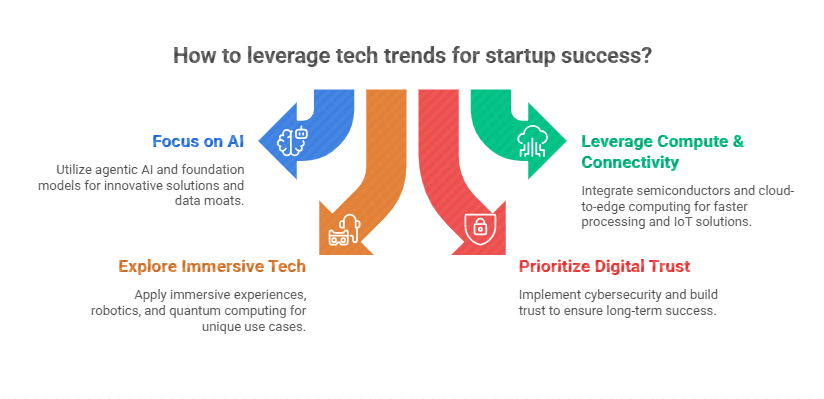
McKinsey’s 2026 tech trends show a world where AI, compute, and digital trust are changing the startup scene. For founders, keeping up with these trends is key to success.
AI Revolution: Agentic AI, Foundation Models, and Data Moats as Differentiators
The AI revolution is speeding up, with agentic AI and foundation models leading the way. These technologies are not just improving products; they’re creating new ones. Founders who use data moats—unique data sets—will have a big advantage.
To thrive, focus on AI solutions that are both new and based on solid data strategies.
Compute and Connectivity: Semiconductors, Cloud-to-Edge, and Advanced Networks
The digital economy’s foundation is changing with semiconductors, cloud-to-edge computing, and advanced networks. These advancements make processing and connectivity faster and more efficient. They’re key for IoT and real-time analytics.
Founders should look into how these trends can speed up their product development and use.
Immersive, Robotics, and Quantum: Where Applied Use Cases Are Maturing Fastest
Technologies like immersive experiences, robotics, and quantum computing are moving fast from labs to real-world use. These areas offer big opportunities for founders who can solve complex problems.
Think about how these new technologies can be used in your field to create new solutions.
Digital Trust and Cybersecurity: The License to Operate at Scale
In a world where data is key, digital trust and cybersecurity are essential for growth. Founders must focus on these to gain customer trust and protect their businesses from threats.
Investing in strong cybersecurity and building a culture of digital trust is vital for lasting success.
Also read : Digital SAT

How Founders Can Win in 2026
To succeed in 2026, you need a winning strategy. The startup world is changing fast. Focus on key areas to stand out.
Build a Vertical AI Wedge with Real Data Advantages
Focus on creating a vertical AI wedge with real data benefits. This means making AI solutions for specific industries. Use data to get ahead of the competition.
Find where AI can solve real problems. Then, make solutions that work well and can grow.
Design for Scale: Modular Stacks, Edge Where Needed, and Data Governance from Day One
Design your startup to grow. Use modular stacks that can change easily. Also, use edge computing to boost performance.
Make sure to focus on data governance from the start. Keep your data accurate, safe, and follow the rules.
Also Read : Global Startup Ecosystems 2026: Tech Trends to Watch Out For
Partner with Ecosystems: Universities, Corporates, and Public Programs to Accelerate Proof and Adoption
Working with ecosystems is key in 2026. Team up with universities, corporates, and public programs to speed up your solution’s adoption.
These partnerships bring new tech, talent, and markets. They help grow and innovate your business.
Capital Strategy: Align Milestones to Today’s Selective VC, Grants, and Corporate Venture
Develop a capital strategy that fits today’s funding scene. Set clear goals and get funding that matches them. This drives growth and success.
By using these strategies, you can win in the 2026 startup world.
Conclusion
The startup world is changing fast. Cities like London, Boston, Paris, Hong Kong, and Bengaluru are moving up or down in rankings. The GSER2025 report shows why it’s key for founders to know these changes.
Final Word: Choose Hubs and Tech Bets That Compound
To win, pick startup hubs that fit your tech goals and the city’s strengths. Boston is now #5 thanks to its AI and biotech. Paris is doing well because of its tech and automation skills. Match your startup’s needs with the right place to use the talent, money, and resources available.
Match City Strengths to Trend Waves
Understanding startup ecosystems is vital. Find city strengths that match new tech trends. This way, your startup can stand out and grow. Build a strong base, use local help, and focus on product, talent, and trust to succeed.
Frequently Asked Questions (FAQs)

Makarand S is a content writer who focuses on importance of soft skills and job readiness. Through his articles, He identifies potential gap areas and demonstrates easy and practical ways to overome them. With a keen interest in Skill Development, Makarand explores the shift in job landscapes and strategies for continuous learning. His articles help readers in preparing for the rapidly evolving nature of work more
Submit the form we will reply within Next 24 hours


Develop Must-Have Skills To Navigate Workplace Challenges And Build Executive Presence
Explore Topics
- AI-Driven Skill Development (7)
- Communication Skills in Indian English (12)
- Confidence Building for Students (5)
- Entrance Test Updates (2)
- Government Job Mindset Training (4)
- Lifelong Learning for Indian Women (3)
- Personality Development for IT/BPO (7)
- Public Speaking in Hindi/Marathi (1)
- Rural Empowerment via Soft Skills (0)
- Soft Skills for Indian Careers (11)
- Strategic Thinking for Entrepreneurs (29)
- text (0)
- Uncategorized (2)