
How to Stop Comparing and Start Owning Your Journey: 5 Simple Steps for Self-Worth
A guide towards self-worth, self-reflection, confidence building.

Ever think, “I wish I spoke like him/her,” or “If only I had his background”? You’re not alone. Over 70% of Indian students compare themselves to others. They feel less because of money, language, or city.
Theodore Roosevelt said, “Comparison is the thief of joy.” We’re here to help you overcome comparison. We’ll show you how to build confidence and love your own journey.
Key Takeaways
- Understand the negative impact of comparison on your mental health.
- Learn strategies to develop awareness and stop comparing yourself.
- Discover the benefits of focusing on your strengths and journey.
- Explore tools and techniques for confidence building.
- Start your journey towards a comparison detox and improved self-worth.
The Hidden Cost of Comparison Culture in India
The hidden cost of comparison in India is a big worry. In a country with high family and social pressures, comparing oneself can cause big problems.
The Unique Pressure Points in Indian Families
Indian families have high hopes for their kids. They want them to do well in school, choose good careers, and make smart life choices. The pressure to do well in school is very strong.
Many families spend a lot on school help to make sure their kids stand out. This makes kids feel like their worth depends on how well they do in school. It leads to a culture where kids compare themselves to others.
How Social Media Amplifies Comparison for Students
Social media like Instagram and Facebook makes it easy to feel like you’re not good enough. Anthony Laye says it shows others’ best moments, making us feel bad about our own. Students compare their real lives to their friends’ perfect online pictures.
This creates a cycle where students feel they’re not as good as their online friends. For those going to study abroad, it’s even harder. They compare their school work, chances, and experiences. We need to understand how social media affects social comparison and help students feel better about themselves.
By knowing these issues and how social media plays a part, we can start to fix the problems of comparison culture in India. We can work towards a place where everyone feels supported and included.
Also Read : 6 Steps to Boost Your Confidence and Unlock Your Potential
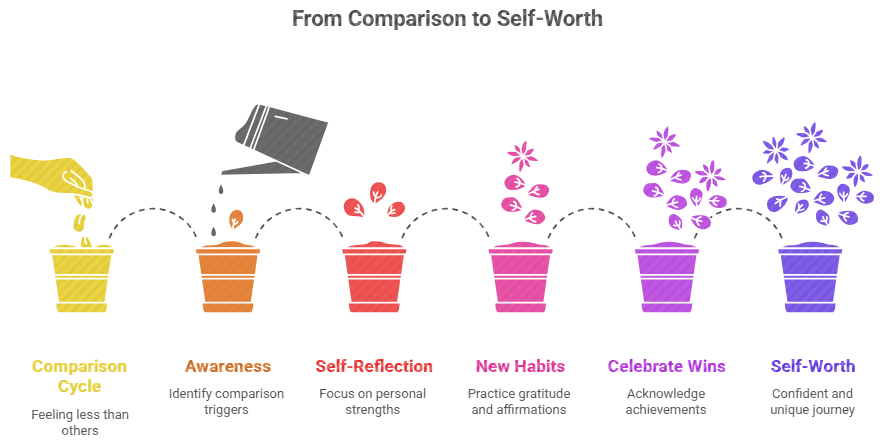
Why We Compare Ourselves to Others?
We often find ourselves trapped in the comparison cycle. But what drives this behavior? The tendency to compare ourselves to others is complex. It affects our well-being in many ways.
At its core, social comparison is a natural human behavior. We evaluate ourselves against others to gauge our success and status. But in today’s digital age, this behavior can harm our mental health and academic performance.
The Psychology Behind Social Comparison
The psychology behind social comparison is rooted in social identity theory. This theory says we find our sense of self through comparing ourselves to others. The rise of social media makes this worse, with its curated highlight reels creating unrealistic expectations.
Research shows constant comparison can lead to depression and anxiety. When we feel worse than others, it can hurt our self-esteem and motivation.
Recognizing Your Comparison Triggers
To stop comparing, we first need to understand what drives this behavior in us. This is what we’ll explore in this section. Comparison is often a response to specific triggers. Identifying these triggers is the first step towards change.
Common Scenarios That Spark Comparison
Following situations can trigger comparison more than others.
- Social gatherings or reunions where achievements are discussed
- Seeing others’ success on professional platforms like LinkedIn
- Family gatherings where comparisons are made directly or indirectly
The Role of Family Expectations and Peer Pressure
Family expectations play a big role in triggering comparison. The pressure to meet certain standards or achieve specific goals can make us compare ourselves to others. This can happen when we see others who seem more successful or accomplished.
Peer pressure can also drive comparison. We often measure our progress or status against that of our peers.
By acknowledging how family expectations and peer pressure influence our tendency to compare, we can start to develop strategies to fight these effects.
Also Read : How to Be Your Authentic Self
How to Stop Comparing Yourself to Others
It’s time to take control of your journey. Our three-week Comparison Detox Plan will help you stop comparing yourself to others. This plan breaks the cycle of comparison and builds a positive, self-focused mindset.
Week 1: Awareness and Identification
The first step is to know when and why you compare. Start a comparison journal to track these moments. Write down the situations, emotions, and triggers.
Action Step: For one week, log every time you compare yourself. Reflect on your feelings and the situations that trigger these comparisons.
Week 2: Replacing Comparison with Self-Reflection
Now that you know your triggers, focus on yourself. Instead of comparing, look at your own progress and goals. Ask yourself questions like “What are my strengths and weaknesses?” or “What can I improve on today?”
Tip: Spend 10 minutes each day on self-reflection. Journal your thoughts, celebrate your wins, and plan your next steps.
Week 3: Building New Mental Habits
The final week is about building new habits. Practice gratitude by appreciating your achievements and others’ without comparing. Use positive affirmations to boost your self-worth and confidence.
Practical Exercise: Write down three things you’re grateful for each day. Share them with someone to celebrate your positive experiences.
By following the Comparison Detox Plan, you’ll stop comparing and focus on your growth and journey.
Practical Self-Worth Building Exercises
We can boost our self-worth with simple exercises every day. These activities help us think positively and stop comparing ourselves to others.
Daily Gratitude Journaling Practice
Gratitude journaling makes us feel better and more confident. It’s about writing down what we’re thankful for each day. This helps us focus on what we have, not what we don’t.
- Choose a special notebook for journaling.
- Write down three things you’re thankful for each day.
- Think about why these things matter to you.
Self-Affirmation Techniques That Actually Work
Self-affirmation is a great way to build self-worth. It’s about recognizing and celebrating our strengths and achievements. For more tips on boosting self-esteem, check out BetterUp’s guide on self-esteem.
- Positive Self Talk
Use uplifting affirmations to motivate yourself.
Example: I am capable and competent. - Mirror Work
Look into the mirror and affirm your worth.
Example: I love and accept myself exactly as I am. - Daily Affirmations
Write affirmations and place them where youll see them often.
Example: I am worthy of love, respect, and happiness.
Celebrating Small Wins: A Weekly Ritual
It’s important to celebrate our achievements, no matter how small. This helps us see our hard work and progress.
Here’s how to make it a weekly ritual:
- Set aside time each week to reflect on your achievements.
- Write down your accomplishments in a ‘Wins Journal’.
- Celebrate by doing something you enjoy, like reading a book or taking a relaxing bath.
Shifting from External Validation to Internal Growth Metrics
As we move through life, it’s key to look inside ourselves for growth. We often judge our success by what others think. But this can make us feel stuck and unhappy. By focusing on our own growth, we can find true happiness.
Creating Your Personal Progress Tracker
Tracking our progress helps us stay on track and motivated. Anthony Laye says it keeps us focused on our own path. Start by picking areas you want to improve in, like work or personal growth.
For example, if you want to get better at public speaking, track your speeches and feedback. This shows your progress and what you need to work on, without comparing to others.
Setting Growth-Oriented Goals vs. Comparison-Based Goals
It’s important to set goals that help us grow, not just compare. Growth goals are about what you want for yourself. Comparison goals are about keeping up with others.
By focusing on our own growth and setting goals that help us grow, we become more positive and self-driven. This way, we not only feel better about ourselves but also achieve more. Let’s start this journey of self-improvement together, celebrating our wins and learning from our mistakes.
Also Read : Design Thinking as a Skill and How It Helps in Marketing
Conclusion
When we face challenges like comparison and self-doubt, Building self-confidence helps us adapt to new places and succeed worldwide.
Adapting to New Cultural Settings
Self-confidence is important for fitting into new cultures. When we feel confident, we can connect better and handle cultural differences. This makes our study abroad and global career experiences better.
Practical Strategies for Confidence Building
Setting goals, celebrating small victories, and getting help from friends and mentors are good steps. These actions boost our self-confidence. This makes us stronger when facing cultural and work challenges.
Author’s Takeaway
Everyones path is different, dont let the comparison steal your happiness.
The more you notice your triggers, the easier it is to break free from the comparison cycle. Focusing on your strengths and small daily wins helps build real, lasting confidence.
Its not about competing, its about cheering yourself on, even for tiny steps forward. Remember: your journey is unique, and you have every right to feel proud of it!
Frequently Asked Questions

Makarand S is a content writer who focuses on importance of soft skills and job readiness. Through his articles, He identifies potential gap areas and demonstrates easy and practical ways to overome them. With a keen interest in Skill Development, Makarand explores the shift in job landscapes and strategies for continuous learning. His articles help readers in preparing for the rapidly evolving nature of work more
Submit the form we will reply within Next 24 hours


Develop Must-Have Skills To Navigate Workplace Challenges And Build Executive Presence
Explore Topics
- AI-Driven Skill Development (7)
- Communication Skills in Indian English (12)
- Confidence Building for Students (5)
- Entrance Test Updates (2)
- Government Job Mindset Training (4)
- Lifelong Learning for Indian Women (3)
- Personality Development for IT/BPO (7)
- Public Speaking in Hindi/Marathi (1)
- Soft Skills for Indian Careers (11)
- Strategic Thinking for Entrepreneurs (29)
- Uncategorized (2)